The World’s 20 Largest Private Medical Clinic Groups in 2026
Private clinic groups are competing to solve an increasingly expensive problem: how to deliver more healthcare without costs rising just as quickly. Ageing populations and rising expectations are increasing demand, while shortages of health workers constrain capacity. These pressures create an opening for businesses that can organize accessible primary care, urgent care and specialist treatment across large networks.
The commercial stakes are substantial. Clinic operators compete for recurring patient relationships, employer contracts and access to clinicians. Larger groups can share infrastructure, coordinate services and negotiate contracts across locations. The March 2026 merger of Premise Health and Crossover Health, creating nearly 900 wellness centers, illustrates the scale this competition has reached.
This ranking examines 20 of the largest private medical clinic groups in 2026, their geographic reach and the business models behind their scale.
The detailed ranking and company profiles follow the graphic below.
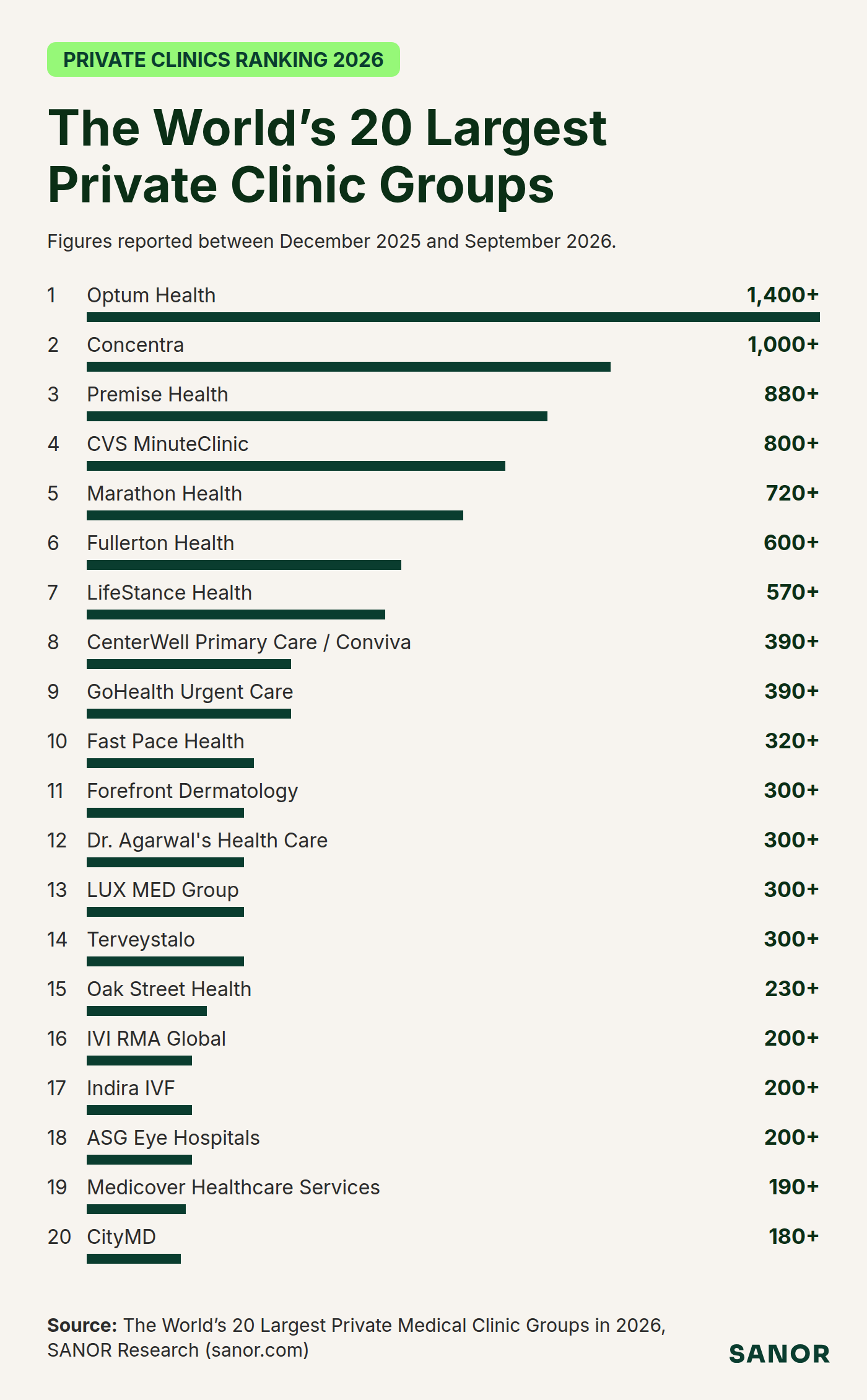
1. Optum Health

- Number of clinics: 1,400+ (as per September 2026)
- Headquarters: Eden Prairie, Minnesota, United States
- Operating markets: United States
- Founded: 2011
- Revenue: US$102.0 billion (2025; Optum Health segment)
- Employees: Not public
- Ownership: UnitedHealth Group
Optum Health operates primary and specialty care practices within UnitedHealth Group’s healthcare-services business. It brings regional medical groups and local practices into a network of more than 1,400 clinics. Its services span primary, specialist and urgent care, as well as ambulatory surgery, with virtual services and care delivered in patients’ homes extending its reach beyond clinic appointments.
UnitedHealth Group also owns UnitedHealthcare, placing the clinic network within a business that combines health insurance and care delivery. Optum Health’s US$102.0 billion revenue figure covers the full segment, including population health, community care and other services beyond its clinics.
2. Concentra

- Number of clinics: 1,000+ (as per June 2026)
- Headquarters: Addison, Texas, United States
- Operating markets: United States
- Founded: 1979
- Revenue: US$2.163 billion (2025)
- Employees: 13,133 (31 December 2025; including managed practices)
- Ownership: Publicly listed, NYSE: CON
Concentra provides occupational healthcare for employers, including treatment of workplace injuries, physical examinations and drug and alcohol screening. Its June 2026 filing identifies 633 freestanding occupational-health centers and 415 permanent clinics at employer worksites: 1,048 locations in total. Worksite clinics therefore account for almost 40% of its locations, making care delivered inside employers’ premises a substantial part of the business.
Revenue rose 13.9% in 2025. Second-quarter 2026 revenue grew a further 10.0% year on year to US$606.0 million. Its freestanding-center count increased from 628 to 633 during the first half of 2026, through three acquired centers and two new openings, with no closures reported in that period.
3. Premise Health

- Number of clinics: 880+ (as per March 2026)
- Headquarters: Brentwood, Tennessee, United States
- Operating markets: United States (47 states and Guam)
- Founded: 2014
- Revenue: Approximately US$1.6 billion (annual revenue reported February 2026; before Crossover merger)
- Employees: 6,500+ (pre-merger Premise figure)
- Ownership: Privately held; OMERS-backed
Premise Health provides employer-sponsored healthcare through onsite, nearsite and virtual services. Its March 2026 merger with Crossover Health created a network of nearly 900 wellness centers across 47 states and Guam, serving more than 400 organizations.
Its customers include employers, unions and health plans, so a single client relationship can provide access to care for an entire employee or member population and their dependents. The combined organization offers services including primary care, occupational health and behavioral health through workplace and community locations. Revenue and workforce figures above refer to Premise before the merger.
4. CVS MinuteClinic

- Number of clinics: 800+ (as per September 2026)
- Headquarters: Woonsocket, Rhode Island, United States
- Operating markets: United States
- Founded: 2000
- Revenue: Not public
- Employees: Not public
- Ownership: CVS Health
MinuteClinic provides primary, acute and preventive care, largely inside CVS Pharmacy and Target stores. Its 800+ clinics are staffed by nurse practitioners and physician associates who treat common illnesses, administer vaccinations and help manage chronic conditions. CVS reports more than five million patients served annually through the business, which accepts scheduled appointments and walk-in visits.
CVS says more than half of MinuteClinic locations now offer adult primary care. That extends the retail model beyond episodic visits, using familiar neighborhood locations for routine medical care. The separate Oak Street Health network focuses on ongoing primary care for older adults.
5. Marathon Health

- Number of clinics: 720+ (as per May 2026)
- Headquarters: Indianapolis, Indiana, United States
- Operating markets: United States (41 states)
- Founded: 2005
- Revenue: Not public
- Employees: Not public
- Ownership: Privately held; investors include General Atlantic, NEA and Oak HC/FT
Marathon Health provides employer-sponsored primary and occupational care through dedicated workplace clinics and shared health centers. Its May 2026 figures identify more than 720 centers across 41 states, more than 1,600 providers and over 100 shared network sites within the total.
The 2024 merger with Everside Health combined two established networks serving employer and union-sponsored clients. Shared centers allow several employers to use one location, while dedicated clinics serve an individual organization’s workforce. Nationwide virtual care complements these physical locations, providing another channel for employees and their families to access services.
6. Fullerton Health

- Number of clinics: 600+ (as per August 2026)
- Headquarters: Singapore
- Operating markets: Asia-Pacific, including Singapore, Indonesia and the Philippines
- Founded: 2010
- Revenue: More than S$900 million (2023; group)
- Employees: 6,000+ (April 2024; group)
- Ownership: Privately held; Mitsubishi Corporation is an investor
Fullerton Health combines primary and specialty care with corporate healthcare and managed-care administration across Asia-Pacific. Mitsubishi Corporation reports approximately 600 owned clinics and more than 20,000 partner providers. Its managed-care role involves coordinating healthcare services and costs between insurers and care providers. The group also offers telemedicine, home care and corporate wellness programs.
The June 2026 acquisition of AdMedika in Indonesia expanded Fullerton’s healthcare administration business, following Mitsubishi’s investment in August 2025. That combination gives Fullerton a role in organizing care well beyond the clinics it owns. Only the owned clinic network is included in the summary count; the much larger partner-provider network is separate.
7. LifeStance Health

- Number of clinics: 570+ (as per December 2025)
- Headquarters: Scottsdale, Arizona, United States
- Operating markets: United States (33 states)
- Founded: 2017
- Revenue: US$1.424 billion (2025)
- Employees: 10,961 (31 December 2025; including supported practices)
- Ownership: Publicly listed, Nasdaq: LFST
LifeStance provides outpatient psychiatry and mental healthcare through its subsidiaries and supported practices. It owns nonmedical assets and provides operating support to those practices under long-term management agreements. Its 572 physical centers at December 2025 operate alongside virtual services. LifeStance reports that virtual and in-person reimbursement rates were substantially similar, supported by payer contracts or policies, making virtual care an established part of its commercial model.
In 2025, the network delivered about nine million visits and ended the year with 8,040 clinicians. Revenue reached US$1.424 billion, approximately 14% above 2024.
8. CenterWell Primary Care / Conviva

- Number of clinics: 390+ (as per June 2026)
- Headquarters: Louisville, Kentucky, United States
- Operating markets: United States
- Founded: 2021
- Revenue: Not public
- Employees: Not public
- Ownership: Humana
CenterWell and Conviva are Humana’s senior primary-care brands. Humana reported 398 operated centers in June 2026, including acquired operations such as The Villages and MaxHealth. The Villages joined in the fourth quarter of 2025 and MaxHealth in the first quarter of 2026, bringing existing practices into the organization.
The total was 48 centers above the end of 2025, an increase of 13.7%, with acquisitions a major contributor. The reported network covers centers operated by Humana; pharmacy, home health and independent physician affiliations are outside that location count.
9. GoHealth Urgent Care

- Number of clinics: 390+ (as per June 2026)
- Headquarters: Atlanta, Georgia, United States
- Operating markets: United States (16 states)
- Founded: 2014
- Revenue: Not public
- Employees: Not public
- Ownership: Privately held; TPG Growth-backed operating joint ventures
GoHealth develops and operates co-branded urgent-care clinics with health-system partners. Its June 2026 announcement describes nearly 400 centers across 16 states and relationships with 12 health systems. Those partnerships connect urgent-care patients to wider networks of primary, specialty and emergency care when follow-up treatment is needed.
The July 2025 launch of 81 UPMC-GoHealth centers incorporated existing UPMC and MedExpress sites in Pennsylvania and West Virginia. The venture combines UPMC clinicians with GoHealth’s operating expertise and digital check-in tools, showing how the model can add regional scale through established clinics.
10. Fast Pace Health

- Number of clinics: 320+ (as per September 2026)
- Headquarters: Franklin, Tennessee, United States
- Operating markets: United States (8 states)
- Founded: 2009
- Revenue: Not public
- Employees: Not public
- Ownership: Privately held; Revelstoke Capital Partners-backed
Fast Pace Health focuses on underserved rural areas and smaller communities. Its centers provide urgent care and selected services including primary care, dermatology, orthopedics and behavioral healthcare across eight US states.
The business grew from one clinic in Collinwood, Tennessee, in October 2009 to more than 320 healthcare centers. Revelstoke Capital Partners has backed Fast Pace since 2016.
11. Forefront Dermatology

- Number of clinics: 300+ (as per September 2026)
- Headquarters: Manitowoc, Wisconsin, United States
- Operating markets: United States
- Founded: 1977
- Revenue: Not public
- Employees: 3,000+ (undated company disclosure)
- Ownership: Partners Group and physician owners
Forefront Dermatology combines medical, surgical and aesthetic services in a physician-led group backed by Partners Group and physician owners. Its company website reports more than 307 practices across the United States. The model brings local practices into a national organization while preserving physicians’ control over clinical decisions.
Swann Dermatology’s five-office practice joined Forefront in late 2025. Acquisitions add established practices and patient relationships, while Forefront supplies central support for payer contracting, recruitment and billing. Physician ownership includes voting rights: the physician owners elect an 11-member physician board that governs the group.
12. Dr. Agarwal's Health Care
- Number of clinics: 300+ (as per June 2026)
- Headquarters: Chennai, India
- Operating markets: India and 9 African countries
- Founded: 1957
- Revenue: INR 2,080 crore (year ended 31 March 2026; group)
- Employees: 7,176 (31 March 2026; group)
- Ownership: Publicly listed
Dr. Agarwal’s operates an eye-care network in India and Africa. June 2026 results identify 304 primary, secondary and tertiary facilities and 1,057 doctors. The sites provide different levels of care, from consultations and diagnosis to surgery. The network comprises 285 facilities in India and 19 across nine African countries, giving the group an international presence while retaining a predominantly Indian base.
Revenue rose 21.6% to INR 2,080 crore in the year ended March 2026, with India contributing 89.9%. The count covers the broader eye-care estate, including eye hospitals, rather than a uniform network of outpatient clinics.
13. LUX MED Group
- Number of clinics: 300+ (as per December 2025)
- Headquarters: Warsaw, Poland
- Operating markets: Poland
- Founded: 1993
- Revenue: PLN 5.9 billion (2025; group)
- Employees: 8,078 (31 December 2025; excluding Dentika)
- Ownership: Bupa
LUX MED is Bupa’s healthcare group in Poland. It serves individuals and employer-funded patients through outpatient consultations, diagnostic testing, hospitals and other services. Its more than 300 owned medical facilities include 16 hospitals; around 3,000 partner facilities extend access and are counted separately.
LUX MED reported PLN 5.9 billion in 2025 revenue and opened 23 medical facilities and one hospital during the year. Mental healthcare was a particular focus: LUX MED says acquiring seven MentalPath facilities and opening four new clinics allowed it to double its psychiatric and psychological care offering.
14. Terveystalo

- Number of clinics: 300+ in Finland (as per September 2026)
- Headquarters: Helsinki, Finland
- Operating markets: Finland and Sweden
- Founded: 2001
- Revenue: EUR 1.279 billion (2025; group)
- Employees: 8,356 (31 December 2025; group)
- Ownership: Publicly listed on Nasdaq Helsinki
Terveystalo provides primary, specialty and occupational healthcare in Finland, serving employers, private patients, insurers and the public sector. Services range from general-practitioner appointments and diagnostics to specialist consultations and day surgery, supported by digital appointments available around the clock. Its Swedish business, Feelgood, focuses on occupational health, including workplace risk assessments, ergonomics and physiotherapy.
The 300+ figure covers the Finnish service network. Group revenue fell 4.6% in 2025, while operating profit rose 18.4% to EUR 137.5 million. Improved operating efficiency supported profitability during a period of weaker demand.
15. Oak Street Health
- Number of clinics: 230+ (as per September 2026)
- Headquarters: Chicago, Illinois, United States
- Operating markets: United States (27 states)
- Founded: 2012
- Revenue: Not public
- Employees: Not public
- Ownership: CVS Health
Oak Street Health provides primary care for older adults. CVS reports more than 230 centers across 27 states, serving over 350,000 patients. Its care teams combine medical, behavioral and social support, with prevention and long-term patient relationships central to the model. Most centers are in underserved communities.
CVS announced 16 center closures in October 2025, citing medical-cost pressure. Management said its emphasis was shifting toward growth within existing centers.
16. IVI RMA Global

- Number of clinics: 200+ (as per September 2026)
- Headquarters: Pozuelo de Alarcón, Madrid, Spain
- Operating markets: 15 countries across Europe, the Americas and the Middle East
- Founded: 2017
- Revenue: Not public
- Employees: 6,000+ (group; as per September 2026)
- Ownership: Privately held; KKR-backed
IVI RMA provides fertility and reproductive-medicine services through brands including IVI, RMA, Boston IVF, CREATE, Genera, Livio and TRIO. It reports more than 200 clinical offices across 15 countries. Its network spans Europe, the Americas and the Middle East, bringing several established national and regional fertility brands into one group.
KKR backs the group, formed through the IVI–RMA merger in 2017. Research and training centers support its clinical activities. The reported network includes laboratory facilities; a separate laboratory total is not added to the count.
17. Indira IVF

- Number of clinics: 200+ in India (as per September 2026)
- Headquarters: Mumbai, India
- Operating markets: India, Nepal and Bangladesh
- Founded: 2011
- Revenue: INR 1,591.4 crore (year ended 31 March 2025; company turnover)
- Employees: Not public
- Ownership: Privately held; EQT BPEA-backed
Indira IVF reports more than 200 centers in India and also operates clinics in Nepal and Bangladesh. Its shared treatment protocols and clinician training aim to maintain consistency across locations, while the wide network gives patients local access for the repeated visits that fertility treatment requires.
Investor EQT, which backed the group in 2023, describes a brand-led model with limited reliance on individual “star doctors”. That investment rationale complements Indira’s emphasis on standardized care across its network. Its Indian operating company reported INR 1,591.4 crore in turnover for the year ended March 2025. The summary count refers to the published Indian network, with overseas clinics identified separately.
18. ASG Eye Hospitals

- Number of clinics: 200+ (as per September 2026)
- Headquarters: Jodhpur, India
- Operating markets: India, Nepal and Uganda
- Founded: 2005
- Revenue: INR 792 crore (year ended 31 March 2024; consolidated operating income)
- Employees: Not public
- Ownership: Privately held; General Atlantic and Kedaara-backed
ASG provides specialist eye care, including diagnosis, treatment and surgery. Founded in Jodhpur in 2005, it has expanded from a regional business into an international network. It describes its more than 200 facilities as eye hospitals, so the total is broader than an outpatient-only clinic count.
General Atlantic and Kedaara invested in 2022, supporting expansion through acquisitions and new sites. The 2023 acquisition of Vasan Eye Care increased ASG’s reported network from 54 to more than 150 eye hospitals, with Vasan retaining its brand. The transaction illustrates how acquiring an established chain can rapidly extend a specialist group’s reach.
19. Medicover Healthcare Services

- Number of clinics: 190+ (as per June 2026)
- Headquarters: Stockholm, Sweden
- Operating markets: Primarily Poland, India and Romania
- Founded: 1995
- Revenue: EUR 1.650 billion (2025; Healthcare Services division)
- Employees: Not public
- Ownership: Medicover AB, listed on Nasdaq Stockholm
Medicover’s Healthcare Services division reports 176 medical clinics and 18 fertility clinics at June 2026, giving a total of 194. Its principal markets are Poland, India and Romania. The division serves employers through healthcare subscriptions, as well as patients paying directly or using public and private insurance. Hospitals, dental clinics and fitness facilities also form part of the business but are excluded from this clinic total.
Divisional revenue grew 13.1% to EUR 1.650 billion in 2025, including hospitals and other services. In August 2026, Medicover announced the sale of its India hospital business to KKR, with completion expected in the fourth quarter. The reported figures precede that transaction.
20. CityMD

- Number of clinics: 180+ (as per September 2026)
- Headquarters: New York, New York, United States
- Operating markets: United States
- Founded: 2010
- Revenue: Not public
- Employees: Not public
- Ownership: Summit Health / VillageMD
CityMD provides physician-led urgent care for minor illnesses and injuries, supported by testing and imaging. Patients can walk in or book ahead, with referrals into Summit Health for specialist follow-up. The 180+ total counts CityMD locations within the wider Summit Health and VillageMD organization.
Sycamore Partners’ 2025 acquisition of Walgreens Boots Alliance left VillageMD, including Summit Health and CityMD, operating as a standalone private business. CityMD remains its distinct urgent-care brand.
What the Ranking Tells Us
Substantial growth is coming from established clinics
Concentra’s freestanding-center revenue grew 7.2% in the second quarter of 2026, with only 0.8% more centers than a year earlier. Visits rose 2.6% and revenue per visit rose 4.6%. In a different specialty and market, Dr. Agarwal’s reported 14.1% revenue growth at facilities established or acquired by March 2023, measured in the year to March 2026.
These results show that established networks still have considerable room to grow. For Concentra, both additional patient activity and higher revenue per visit contributed; for Dr. Agarwal’s, older facilities continued to grow alongside new openings. For operators with available clinical capacity, attracting more patients to existing sites offers a route to expansion without the full investment required to establish another clinic.
Employer-funded care offers scale, with growing pressure on prices
Three of the five highest-ranked groups—Concentra, Premise and Marathon—focus on employer healthcare. Fullerton in Asia-Pacific and Medicover in Europe also serve corporate customers. A network spanning several cities can compete for a company’s entire workforce, an opportunity Premise identified when it combined its network with Crossover. This gives geographic expansion a specific commercial purpose: serving larger accounts across more of their locations.
Buyers are scrutinizing that spending. In Business Group on Health’s June 2026 survey of 127 employers, covering a predominantly US population, 60% emphasized prevention and primary care, while 71% used competitive tenders to seek lower prices. For employer-focused groups, the opportunity to win a larger share of healthcare spending comes with pressure on contract terms. Broad coverage helps secure a place in the tender; price and service performance help determine who wins and retains the account.
Expansion strategies are diverging
The Premise–Crossover merger and ASG’s acquisition of Vasan show how whole networks can be combined to gain geographic reach, clinicians and established patient relationships. Acquisition-led expansion also helped Humana’s CenterWell and Conviva network reach 398 centers in June 2026, up from 350 at the end of 2025.
Yet another large senior-care operator was reducing its estate: CVS announced 16 Oak Street closures in October 2025, citing medical-cost pressure and shifting its emphasis toward growth within existing centers. The two senior-care networks serve the same broad demographic, but their expansion decisions differ. This is a market in which acquiring more capacity and concentrating resources on existing locations are both active strategies. An ageing population supports demand; the economics of each care model shape how companies respond.
Market Outlook
The longer-term opportunity is in delivering more care through accessible local services. WHO projects that the global population aged 60 and over will reach 1.4 billion by 2030, increasing the need for continuing care and age-related specialties. The expansion of surgery without an overnight stay across OECD countries also widens the range of treatment that can be delivered through outpatient facilities.
Further combinations of established chains could produce the largest changes in the ranking, particularly among the operators clustered around 200–400 locations. Alongside those transactions, groups can expand the services available through their existing sites: MinuteClinic’s move into ongoing primary care and Fast Pace’s combination of urgent care with selected specialties illustrate that opportunity.
Methodology and Limitations
SANOR compiled this ranking on a best-effort basis from company websites, annual reports, regulatory filings and transaction announcements available by 15 September 2026. Public data on private clinic groups are fragmented: operators use different definitions of a clinic, report at different dates and vary widely in how much they disclose.
We ranked the groups by their approximate reported number of physical locations, explaining material differences in scope in the profiles. The ranking may omit other large operators where suitable information was unavailable or not identified, and the order of similarly sized groups should be treated as indicative.
- Coverage. “Private” refers to care delivered outside government-run services, so the selection includes both publicly listed and privately held companies. Distinct networks under the same parent, such as MinuteClinic and Oak Street Health, have separate entries.
- Location counts. The focus is primary care, urgent care, workplace healthcare and medical specialties. Where companies report a broader total that includes eye hospitals, laboratories or other medical facilities, the profile identifies that scope. Partner-provider networks are excluded from owned-location totals, and facilities already included in a group’s figure are not added again. Finland-only and India-only counts are labeled explicitly.
- Rounding. Summary bullets use a consistent plus-sign format to indicate scale: for example, LifeStance’s 572 centers become 570+. Exact figures remain in the text where available. When a company says “nearly” or “approximately,” the rounded summary is an approximation, not a verified minimum; the profile preserves the company’s wording.
- Reporting dates. The month and year beside each count identify the reporting period. For an undated company webpage, they identify when we reviewed it. The figures therefore come from different dates and should not be read as a single-day snapshot.
- Revenue and employees. These provide business context and do not determine the ranking. Revenue stays in its reported currency, with the period and group or divisional scope stated. Employee figures follow the cited disclosure; clinicians, contractors and managed-practice staff are not interchangeable categories. “Not public” means we found no usable figure for the profiled business in the sources reviewed.
Hospital-only, dental-only, diagnostic-only and virtual-only operators are outside this selection, along with dedicated dialysis, infusion and standalone surgery-center chains. Headquarters refer to the operating business or its centrally managed parent; founding years reflect the origin of the named business or brand.
Sanor publishes for general information. This publication is not medical, financial, or investment advice.
The Private Clinic Playbook
Grow revenue at each location and build a commercial model that can scale across a clinic group.
Sanor never sells your personal information. By providing this information you agree to Sanor’s Privacy Policy and Terms of Service.

SANOR research follows the principles of ISO 20252:2019 and the ICC/ESOMAR International Code on Market, Opinion and Social Research and Data Analytics, and is conducted in line with our Independence Policy. Our published reports follow our Editorial Standards.
SANOR research is funded through advisory engagements and research licensing. We do not accept vendor sponsorship, paid placement, or advertising.
All publications are provided for general information only. They do not constitute medical, financial, or investment advice and do not account for the circumstances of any specific business or individual.