The 15 Largest Telehealth Companies in 2026
Telehealth is no longer a narrow category built around video consultations. It now spans virtual-first care, digital pharmacies, remote chronic-care platforms, mental-health services, physician software and hybrid healthcare groups delivering a meaningful share of care online.
That makes the competitive landscape much broader than a list of pure-play telehealth companies.
For this ranking, SANOR includes publicly traded healthcare and digital-health companies where telehealth is either a core business or a major operating platform with substantial patient or provider reach. Companies are ranked by total market capitalization as of September 11, 2026.
The detailed ranking and company profiles follow the graphic below.
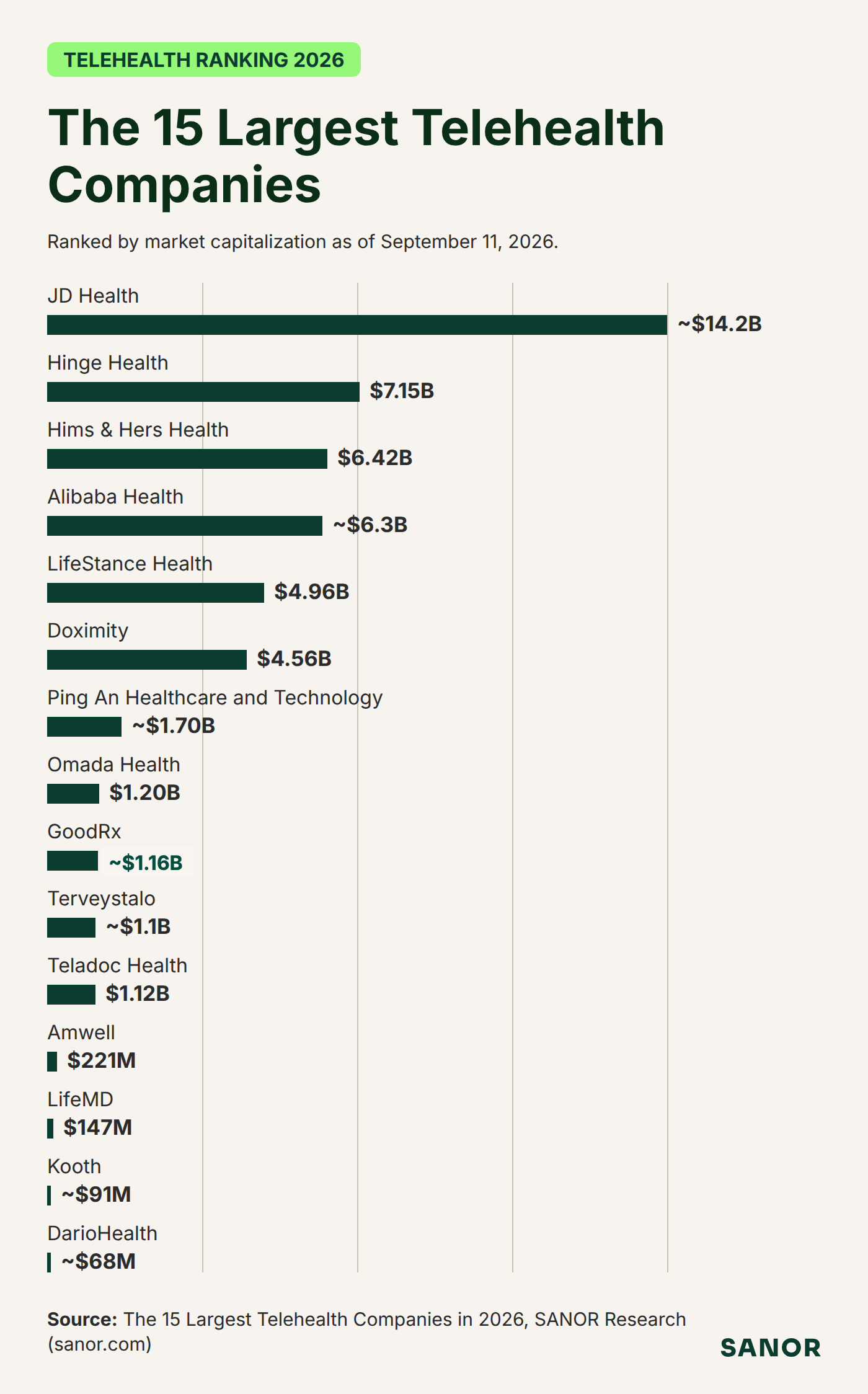
1. JD Health (6618.HK)

- Headquarters: Beijing, China
- Primary Services: Digital healthcare, online consultations, pharmacy and health services
- Market Cap: Approximately $14.2 billion
- Revenue: RMB 73.4 billion (FY2025)
- Telehealth Role: Major business within a broader digital-health platform
JD Health combines one of China’s largest online pharmaceutical and healthcare retail businesses with a large digital-care operation spanning online consultations, specialist clinics, chronic-disease management and other health services.
The scale of that digital-care activity is significant. During the first half of 2025, JD Health said its average daily online consultation volume exceeded 500,000. The company has also expanded specialist virtual services in areas including dermatology, mental health, oncology and chronic-disease management.
JD Health generated RMB 73.4 billion in revenue in 2025, up 26.3% from the previous year, and reported 217.7 million annual active users at year-end.
Its market capitalization was approximately HKD 110.8 billion on September 11, 2026, equivalent to roughly $14.2 billion.
2. Hinge Health (HNGE)

- Headquarters: San Francisco, California
- Primary Services: Virtual musculoskeletal care
- Market Cap: $7.15 billion
- Revenue: $587.9 million (FY2025)
- Telehealth Role: Core business
Hinge Health has built one of the most valuable virtual-care businesses around a single clinical category: musculoskeletal care.
Its platform combines digital exercise therapy, clinician-led care, AI-assisted movement technology and devices to treat back, joint and muscle conditions remotely.
Revenue reached $587.9 million in 2025, up from $390.4 million in 2024, representing growth of approximately 50.6%. Hinge completed its IPO in May 2025 and had a market capitalization of $7.15 billion on September 11, 2026.
That makes Hinge the largest publicly traded company in this ranking whose business is concentrated almost entirely in virtual care.
3. Hims & Hers Health (HIMS)

- Headquarters: San Francisco, California
- Primary Services: Direct-to-consumer virtual healthcare
- Market Cap: $6.42 billion
- Revenue: $2.35 billion (FY2025)
- Telehealth Role: Core business
Hims & Hers has scaled a direct-to-consumer healthcare model that combines online consultations, prescriptions, treatment products and ongoing care across multiple consumer-health categories.
The company operates in areas including weight management, sexual health, hair loss, dermatology, hormone health and mental health.
Revenue reached $2.35 billion in 2025, up approximately 59% year over year, while subscriptions exceeded 2.5 million by the end of the year.
Hims & Hers had a market capitalization of $6.42 billion on September 11, 2026.
4. Alibaba Health Information Technology (0241.HK)

- Primary Services: Digital health, pharmaceutical retail and online healthcare
- Market Cap: Approximately $6.3 billion
- Revenue: RMB 34.3 billion (FY ended March 2026)
- Telehealth Role: Major business within a broader digital-health platform
Alibaba Health is another example of how difficult it has become to separate telehealth from the wider digital-health market.
Pharmaceutical retail and healthcare e-commerce remain major parts of the business, but Alibaba Health also operates a substantial digital medical-services network. The company has reported more than 250,000 contracted physicians, pharmacists and nutritionists providing online health consultations through its ecosystem.
For the year ended March 31, 2026, Alibaba Health generated RMB 34.3 billion in revenue, up 12% from the previous year.
Its market capitalization was approximately HKD 48.82 billion on September 11, equivalent to roughly $6.3 billion.
5. LifeStance Health Group (LFST)

- Headquarters: Scottsdale, Arizona
- Primary Services: Outpatient mental healthcare
- Market Cap: $4.96 billion
- Revenue: $1.42 billion (FY2025)
- Telehealth Role: Major delivery channel
LifeStance operates one of the largest outpatient mental-health networks in the United States, combining physical clinics with virtual appointments.
At the end of 2025, the company had 8,040 licensed clinicians across 33 states. Those clinicians treated more than one million unique patients through approximately nine million visits during the year.
Unlike virtual-only mental-health companies, LifeStance is a hybrid provider. Telehealth nevertheless functions as a major company-wide delivery channel rather than an ancillary service.
Its market capitalization was approximately $4.96 billion on September 11, 2026.
6. Doximity (DOCS)

- Headquarters: San Francisco, California
- Primary Services: Digital platform and workflow technology for medical professionals
- Market Cap: $4.56 billion
- Revenue: $644.9 million (FY ended March 2026)
- Telehealth Role: Major enabling platform
Doximity represents a different part of the telehealth market: infrastructure rather than direct patient care.
Its professional network is widely used by U.S. physicians, and its workflow tools include products that allow clinicians to communicate with patients through secure voice and video calls.
Doximity reported $644.9 million in revenue for fiscal 2026, up 13% year over year. It also reported more than 800,000 active prescribers using its workflow tools during its fiscal fourth quarter.
The company was valued at approximately $4.56 billion on September 11, 2026.
7. Ping An Healthcare and Technology (1833.HK)

- Headquarters: Shanghai, China
- Primary Services: Online healthcare and health management
- Market Cap: Approximately $1.70 billion
- Revenue: RMB 5.47 billion (FY2025)
- Telehealth Role: Core business
Ping An Healthcare and Technology operates a digital healthcare platform spanning online consultations, family-doctor services, health management and corporate healthcare.
The company’s services include audio and video consultations, hospital referrals, second opinions and other forms of digitally delivered care.
Its corporate health business served more than 6,700 paying corporate clients in 2025, while its AI Doctor was used by nearly 12 million people.
Ping An Healthcare had a market capitalization of approximately HKD 13.24 billion on September 11, equivalent to around $1.70 billion.
8. Omada Health (OMDA)

- Primary Office: South San Francisco, California
- Primary Services: Virtual chronic-condition care
- Market Cap: $1.20 billion
- Revenue: $260.2 million (FY2025)
- Telehealth Role: Core business
Omada Health focuses on digitally delivered care for chronic conditions including diabetes, hypertension, obesity and musculoskeletal conditions, alongside behavioral-health support.
Its model combines software with health coaches, clinicians, physical therapists and other care-team members.
By the end of 2025, Omada had more than 2,000 customers and 886,000 enrolled members. The company has also become increasingly involved in supporting patients using GLP-1 medications.
Omada was valued at approximately $1.20 billion on September 11, 2026.
9. GoodRx (GDRX)

- Headquarters: Santa Monica, California
- CEO: Wendy Barnes
- Primary Services: Prescription savings, pharmaceutical services and telehealth
- Market Cap: Approximately $1.16 billion
- Revenue: $796.9 million (FY2025)
- Telehealth Role: Significant business within a broader consumer-health platform
GoodRx is best known for prescription-price comparison and medication savings, but its consumer-health platform also includes virtual care through GoodRx Care.
Consumers can complete online medical visits through the platform, with physician-owned professional entities providing clinical services.
Telehealth is not GoodRx’s largest business. Prescription transactions generated 68% of company revenue in 2025, making its inclusion different from virtual-first companies such as Hinge Health or Omada.
GoodRx generated $796.9 million in revenue in 2025.
Its market capitalization was approximately $1.16 billion on September 11, 2026.
10. Terveystalo (TTALO.HE)

- Headquarters: Helsinki, Finland
- CEO: Ville Iho
- Primary Services: Physical and digital healthcare
- Market Cap: Approximately $1.1 billion
- Revenue: €1.28 billion (FY2025)
- Telehealth Role: Major delivery channel
Terveystalo shows how deeply telehealth can be embedded inside a conventional healthcare provider.
The Finnish private healthcare group operates a large network of clinics and hospitals, but it also delivered approximately 1.19 million remote appointments in 2025, compared with around 4.55 million physical appointments in its Healthcare Services segment.
Its app has around 2.7 million registered users, and digital appointments are available around the clock.
Terveystalo generated €1.279 billion in revenue in 2025 and employed approximately 14,400 healthcare and other professionals.
Its market capitalization was approximately $1.1 billion on September 11, 2026.
11. Teladoc Health (TDOC)

- Headquarters: New York, New York
- Primary Services: Virtual primary care, chronic care and mental healthcare
- Market Cap: $1.12 billion
- Revenue: $2.53 billion (FY2025)
- Telehealth Role: Core business
Teladoc remains one of the world’s largest dedicated virtual-care operators by revenue and patient reach, even after a sharp decline in its public-market valuation from pandemic-era levels.
Its services span primary and urgent care, chronic-condition management, mental health and expert medical opinions. The company also owns BetterHelp.
Teladoc completed approximately 17.1 million virtual-care visits in 2025, while around 102 million U.S. members had access to at least one of its services.
Despite generating $2.53 billion in 2025 revenue, Teladoc was valued at only $1.12 billion on September 11, 2026.
12. American Well (Amwell) (AMWL)

- Headquarters: Boston, Massachusetts
- Primary Services: Enterprise virtual-care technology
- Market Cap: $221 million
- Revenue: $249.3 million (FY2025)
- Telehealth Role: Core business
Amwell focuses on the enterprise side of virtual care, providing software, devices and infrastructure to health systems, insurers and government customers.
At the end of 2025, its technology supported approximately 50 health plans covering more than 90 million lives and around 80 major U.S. health systems. Since its founding, Amwell said its technology had supported more than 37.6 million virtual-care visits.
Its market capitalization stood at approximately $221 million on September 11, 2026.
13. LifeMD (LFMD)

- Headquarters: New York, New York
- Primary Services: Direct-to-consumer telehealth
- Market Cap: $147 million
- Revenue: $194.1 million (FY2025)
- Telehealth Role: Core business
LifeMD operates a direct-to-consumer virtual-care platform across weight management, men’s and women’s health, primary care and other chronic and lifestyle-related conditions.
The company had approximately 356,000 active patient subscribers by June 2026, up from roughly 328,000 at the end of 2025. Since inception, its platform has served more than 1.55 million patients and customers.
LifeMD’s listed corporate predecessor dates to 1994, but the business later operated as Conversion Labs before adopting the LifeMD name in 2021.
Its market capitalization was approximately $147 million on September 11, 2026.
14. Kooth (KOO.L)

- Headquarters: London, United Kingdom
- Primary Services: Digital mental healthcare
- Market Cap: Approximately $91 million
- Revenue: £63.3 million (FY2025)
- Telehealth Role: Core business
Kooth provides digital mental-health services in the United Kingdom and United States, with programs covering children, young people and adults.
Unlike consumer-subscription platforms, much of Kooth’s revenue comes from governments, healthcare organizations and other institutional customers.
The company generated approximately £63.3 million in revenue in 2025, compared with £66.7 million in 2024.
Its market capitalization was approximately $91 million on September 11, 2026.
15. DarioHealth (DRIO)

- Corporate Headquarters: Caesarea, Israel
- Primary Services: Virtual chronic-condition management
- Market Cap: Approximately $68 million
- Revenue: $22.36 million (FY2025)
- Telehealth Role: Core business
DarioHealth provides digitally delivered chronic-care programs spanning diabetes, hypertension, weight management, musculoskeletal conditions and behavioral health.
Its platform combines connected devices, software, analytics, coaching and virtual clinical support.
Dario generated $22.36 million in 2025 revenue, down from $27.04 million in 2024. Services accounted for approximately $14.9 million of annual revenue.
Its market capitalization was approximately $68 million on September 11, 2026.
What the Ranking Tells Us About the Telehealth Market
Telehealth is becoming a delivery model, not a standalone sector
The largest companies in the ranking do not fit a single business model.
JD Health and Alibaba Health combine virtual medical services with pharmaceutical retail and healthcare e-commerce. LifeStance and Terveystalo combine physical and digital care. Doximity supplies technology clinicians can use to reach patients remotely.
The common thread is not that these companies are all “telehealth companies” in the traditional sense. It is that remote healthcare has become a meaningful part of how they deliver, organize or enable care.
China has some of the world’s largest digital-care platforms
A U.S.-only view materially understates the scale of the global telehealth market.
JD Health said its average daily online consultation volume exceeded 500,000 during the first half of 2025.
Ping An Healthcare operates another large online-care platform, while Alibaba Health combines digital consultations with one of China’s largest healthcare-commerce ecosystems.
Hinge Health stands out among telehealth-focused specialists
The broader ranking puts JD Health first because of the size of the entire listed company. But among businesses concentrated primarily in virtual care, Hinge Health stands out.
Its $7.15 billion market capitalization exceeds Hims & Hers, Omada and Teladoc, despite Hinge focusing primarily on musculoskeletal care.
That makes its position unusual: one of the most valuable dedicated telehealth businesses in the public markets is built around a relatively narrow clinical category.
Teladoc’s operating scale and valuation have diverged
Teladoc remains much larger operationally than its current market capitalization suggests.
The company generated approximately $2.53 billion in 2025 revenue and completed more than 17 million virtual visits, yet its market capitalization stood at only $1.12 billion in September 2026.
That places Teladoc below several much younger and smaller companies in public-market value.
Consolidation is shrinking the pool of independent telehealth companies
The public-company universe is also changing through acquisitions.
Talkspace would previously have ranked comfortably within this list. Universal Health Services completed its acquisition of Talkspace in August 2026, after which Talkspace was delisted and ceased trading as an independent public company.
That is why Talkspace does not appear in a ranking measured on September 11, 2026.
Conclusion
The competitive landscape in telehealth is broader than the traditional group of virtual-first providers.
The largest participants now include digital-health platforms, hybrid healthcare groups, physician technology companies and consumer-health businesses alongside dedicated virtual-care operators.
JD Health leads this ranking by total company market capitalization, while Hinge Health stands out as the largest company whose business is concentrated predominantly in virtual care.
That distinction matters. Market capitalization measures the value of the entire listed company, not the value or market share of its telehealth operation.
As virtual care becomes embedded across primary care, specialist care, pharmacy, mental health, chronic-disease management and traditional healthcare systems, the boundary between a “telehealth company” and a healthcare company that delivers care digitally will continue to blur.
Methodology & Limitations
SANOR ranked publicly traded healthcare and digital-health companies where telehealth is either a core business or a major operating platform with substantial patient or provider reach.
To qualify, a company had to operate primarily within healthcare or digital health and have remote care delivery, virtual healthcare services or technology enabling remote care as a meaningful part of its business.
The ranking includes both telehealth-focused companies and broader healthcare businesses with substantial telehealth operations. It excludes diversified conglomerates, insurers and retailers where telehealth represents a comparatively small part of the overall company. For that reason, companies such as Amazon, CVS Health and UnitedHealth Group are not included despite operating virtual-care services.
Companies are ranked by total market capitalization as of September 11, 2026, not by telehealth revenue, patient volume or estimated telehealth market share. For diversified companies such as JD Health, Alibaba Health, GoodRx and Terveystalo, market capitalization therefore reflects businesses beyond telehealth.
Non-U.S. market capitalizations were converted to U.S. dollars for comparison. Market values can change materially from day to day.
Operating metrics such as users, members, subscribers, consultations, appointments, covered lives and patients are company-reported and are not directly comparable across companies.
The boundary between telehealth, digital health and conventional healthcare is inherently subjective. SANOR therefore uses the scope above to create a consistent ranking while separately identifying whether telehealth is a company’s core business, major business, major delivery channel or enabling platform.
Sanor publishes for general information. This publication is not medical, financial, or investment advice.
The Private Clinic Playbook
Grow revenue at each location and build a commercial model that can scale across a clinic group.
Sanor never sells your personal information. By providing this information you agree to Sanor’s Privacy Policy and Terms of Service.

SANOR research follows the principles of ISO 20252:2019 and the ICC/ESOMAR International Code on Market, Opinion and Social Research and Data Analytics, and is conducted in line with our Independence Policy. Our published reports follow our Editorial Standards.
SANOR research is funded through advisory engagements and research licensing. We do not accept vendor sponsorship, paid placement, or advertising.
All publications are provided for general information only. They do not constitute medical, financial, or investment advice and do not account for the circumstances of any specific business or individual.