The Latest AI in Healthcare Statistics (2026)
AI is becoming widespread across healthcare.
Hospitals, health systems, physicians, nurses, and other healthcare professionals are increasingly using AI tools in their work.
AI can help with documentation, scheduling, billing, research, patient communication, and other tasks. But healthcare professionals also have concerns around accuracy, privacy, trust, and how AI should be used.
So how widely is AI being used in healthcare? What are hospitals and healthcare professionals using it for, which tools are gaining adoption, and what do they think about it?
This article covers the latest statistics, trends, and surveys on the state of AI in U.S. healthcare in 2026.
Editor’s Picks
- 81% of physicians use AI professionally.
- 62.6% of U.S. hospitals using Epic have adopted ambient AI documentation tools.
- 50% of surveyed U.S. healthcare organizations have implemented generative AI.
- Around one-third of large healthcare organizations are operating AI at scale.
- 49% of large healthcare organizations are still experimenting with generative or agentic AI.
- 39% of physicians use AI to summarize medical research or standards.
- 27% of surveyed physicians reported no AI training from any source.
- 70% of physicians think AI could automate tasks that contribute to burnout.
- 19% of surveyed healthcare organizations have implemented agentic AI.
- 82% of healthcare leaders expect positive ROI from generative AI.
- 34% of U.S. adults have used an AI chatbot for a health-related purpose.
- 72% of Americans want healthcare providers to tell them when AI is being used in their care.
Hospital AI Adoption Statistics
71% of surveyed US hospitals used predictive AI integrated with their EHR in 2024 (HHS/ASTP–ONC)
The share increased from 66% in 2023. The federal analysis included 2,080 non-federal acute-care hospitals with informative responses in 2024; missing and “do not know” responses were excluded.
Predictive AI uses statistical analysis and machine learning to classify or estimate risks, such as readmissions and missed appointments. This measure describes hospital adoption, not market revenue or generative AI adoption.
Hospital and Health System AI Use Statistics
50% of surveyed U.S. healthcare organizations have implemented generative AI (McKinsey)
More than 80% of organizations that had implemented generative AI had already deployed their first use cases to end users.
Around one-third of large healthcare organizations operate AI at scale (Deloitte)
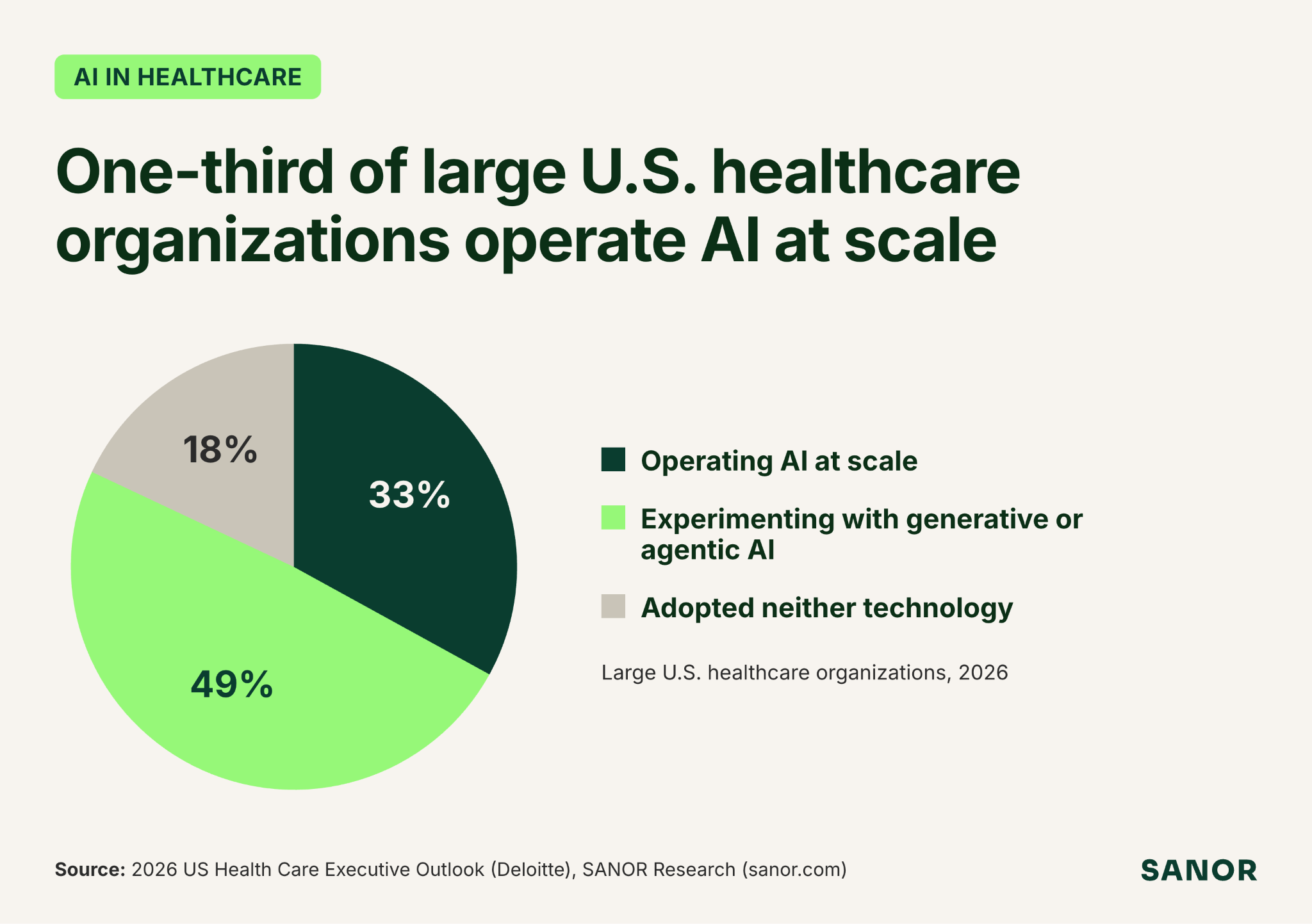
Another 49% were experimenting with generative or agentic AI.
18% had not adopted either technology.
62.6% of U.S. hospitals using Epic have adopted ambient AI documentation tools (American Journal of Managed Care)
Among Epic hospitals, 1,744 had adopted an ambient AI tool.
70.2% of nonprofit Epic hospitals have adopted ambient AI, compared with 28.8% of for-profit hospitals (American Journal of Managed Care)
Ownership was one of the largest differences identified in the study.
Ambient AI adoption was more than twice as high among nonprofit hospitals as for-profit hospitals.
64.7% of metropolitan Epic hospitals have adopted ambient AI (American Journal of Managed Care)
That compares with 54.3% of nonmetropolitan hospitals.
Hospitals with stronger operating margins were also more likely to adopt ambient AI.
Ambient AI adoption reaches 73.1% among Epic hospitals with the highest staffing-adjusted workloads (American Journal of Managed Care)
That compares with 61.7% among hospitals in the lowest workload quartile.
Hospitals with heavier workloads appear more likely to adopt ambient documentation tools.
Why Healthcare Organizations Use AI
54% of care-delivery organizations have implemented generative AI for clinical productivity (McKinsey)
Clinical productivity is one of the most common generative AI use cases among care-delivery organizations.
These tools can support documentation, summarization, and other parts of healthcare workflows that require significant staff time.
Research summaries and documentation are leading physician AI uses (AMA)
In the AMA’s 2026 survey, 39% of physician respondents used AI to summarize medical research or standards of care, and 30% used it to create discharge instructions, care plans or progress notes.
Another 28% used AI for documentation of billing codes, medical charts or visit notes. These findings describe surveyed physicians, rather than clinicians at Epic organizations specifically.
19% of surveyed physicians use AI to draft patient portal responses (AMA)
The AMA’s 2026 survey also found that 28% used AI for documentation of billing codes, medical charts or visit notes.
These figures describe reported physician use; they do not establish adoption rankings for nurses or for individual EHR platforms.
44.7% of AI-documentation users reported less EHR frustration in one trial (JAMA Network Open)
In a nonrandomized trial at Atrium Health, 38 of 85 survey respondents using an AI documentation tool reported less frustration with their EHR, compared with 8 of 55 respondents in the control group (14.5%).
The study measured self-reported changes after five weeks. It was not a national estimate and does not establish that all AI tools improve EHR experience.
Changes in AI Use in Healthcare
81% of physicians use AI professionally, up from 38% in 2023 (AMA)
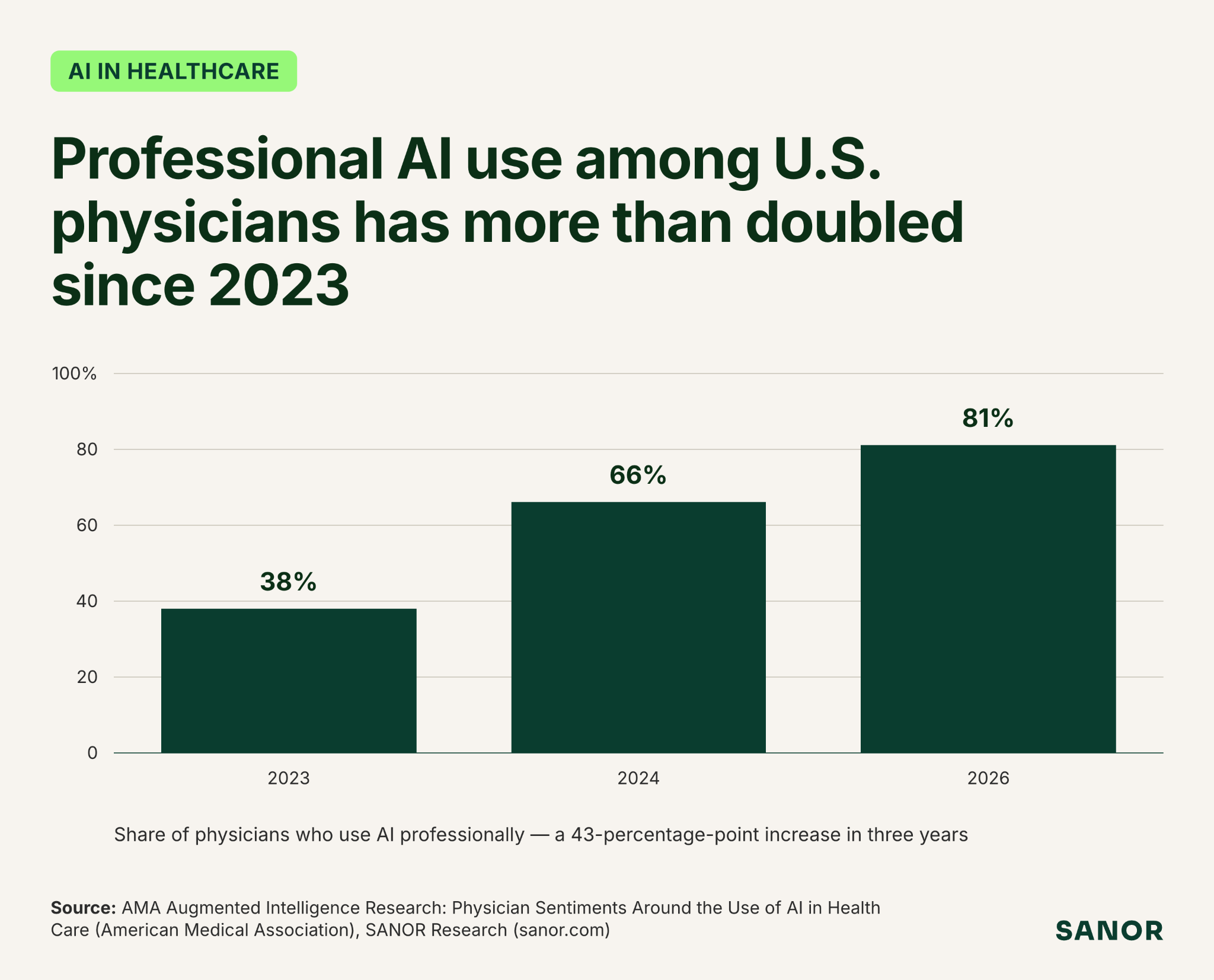
Usage increased to 66% in 2024 before reaching 81% in 2026.
That is a 43-percentage-point increase in three years.
Physicians now use an average of 2.3 AI use cases (AMA)
That is up from 1.1 use cases per physician in 2023.
Physicians are not only adopting AI at higher rates but are also using it for more tasks.
Generative AI implementation doubled between 2023 and 2025 (McKinsey)
25% of surveyed healthcare organizations had implemented generative AI in late 2023.
That increased to 47% in 2024 and 50% in the latest survey.
Nearly 65% of nurses say they are using more AI than one year ago (McKinsey)
More than three-quarters reported using AI in their daily work to some degree.
AI Training, Trust and Safeguards
27% of surveyed physicians reported no AI training from any source (AMA)
Among 1,419 respondents to the training question in the AMA’s 2026 survey, 27% reported no AI training from any source and 73% reported some training.
The measure covers training received, rather than whether physicians considered their training adequate.
92% of physicians want more education and training on AI (AMA)
Physicians most frequently cited clinical evidence and practical implementation guides as resources that would help them evaluate and use AI.
88% of physicians say safety and efficacy validation is important for AI adoption (AMA)
86% also said data privacy assurances are important.
85% want physicians to be consulted or directly involved in decisions about AI adoption.
72% of Americans want providers to disclose when they use AI (Pew Research Center)
Most Americans want disclosure across both clinical and administrative uses of AI.
81% of Americans want to be told when AI is used to make a diagnosis (Pew Research Center)
The same percentage want disclosure when AI is used to analyze medical scans.
80% want to know when it is used to explain laboratory results.
56% want disclosure even when AI is used to schedule an appointment (Pew Research Center)
64% want to be told when AI is used to order prescription refills.
72% want disclosure when AI takes notes during a medical appointment.
How Healthcare Professionals Use AI
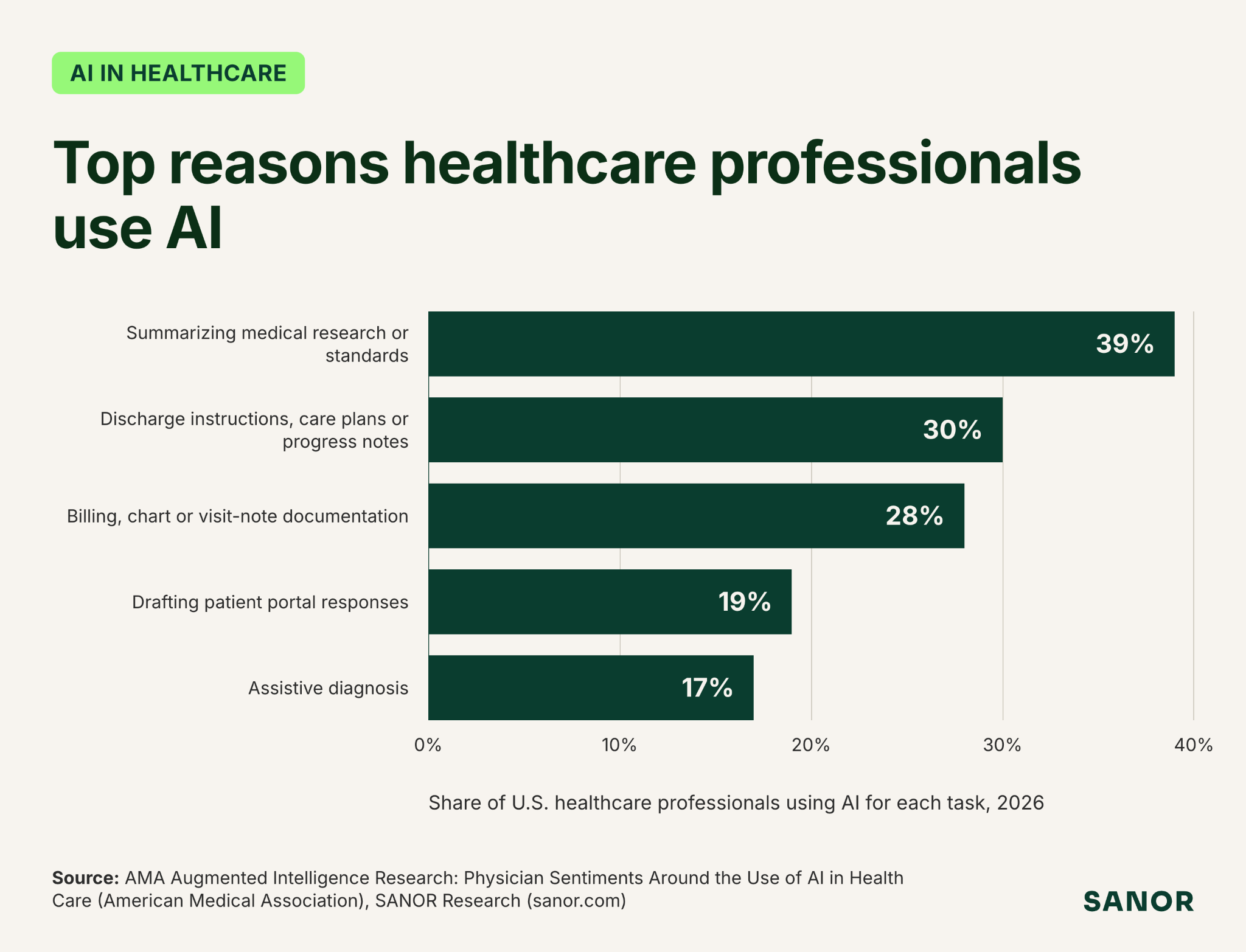
39% of physicians use AI to summarize medical research or standards (AMA)
This was the most common professional AI use reported by physicians.
AI can help physicians work through large amounts of information more quickly, including research, guidelines, and other professional material.
30% of physicians use AI for discharge instructions, care plans or progress notes (AMA)
Documentation is one of the biggest areas of physician AI use.
Related tools can create draft notes, summarize information, and help produce other written materials used during or after visits.
28% use AI for billing, chart or visit-note documentation (AMA)
The same percentage use AI to create chart summaries.
Several of the most common physician AI uses are therefore connected to documentation rather than direct diagnosis or treatment.
19% use AI to draft patient portal responses (AMA)
18% reported using AI for translation.
Patient communication is another area where generative AI can reduce the amount of writing physicians and staff need to complete manually.
17% of physicians use AI for assistive diagnosis (AMA)
Assistive diagnosis remains less common than research, documentation, chart summarization, and other workflow-related uses.
That helps explain why much of healthcare AI adoption so far has centered on productivity and administrative work.
23% of frontline nurses say they do not use AI (McKinsey)
Only around 2% said AI was embedded in everything they do.
Nursing AI adoption therefore varies widely, from no use at all to heavy daily use.
Around 10% of nurses are heavy AI users (McKinsey)
McKinsey classified these nurses as AI “superusers.”
These users rated their level of AI use between 8 and 10 on a 10-point scale.
Which AI Tools and Platforms Are Healthcare Organizations Using?
DAX Copilot, Abridge and ThinkAndor account for more than 80% of ambient AI implementations among Epic hospitals (American Journal of Managed Care)
The three products were the most commonly adopted ambient documentation tools identified in the study.
Ambient AI tools capture conversations between clinicians and patients and generate draft clinical notes.
62.6% of Epic hospitals have adopted at least one ambient AI tool (American Journal of Managed Care)
1,744 Epic hospitals had adopted an ambient AI documentation product.
Hospitals source predictive AI from EHR vendors, third parties and internal development (HHS/ASTP–ONC)
Among surveyed hospitals using predictive AI in 2024, 80% sourced it from their EHR developer, 52% from third parties and 50% developed it internally. These categories overlap.
The federal analysis uses American Hospital Association survey data and covers predictive AI across EHR vendors, rather than generative AI or Epic organizations alone.
28% of surveyed physicians use AI to generate chart summaries (AMA)
The AMA’s 2026 physician survey identifies chart summarization as another established AI workflow alongside research summaries, documentation and patient-message drafting.
What Healthcare Professionals Think About AI
76% of physicians think AI improves their ability to care for patients (AMA)
That is up from 65% in 2023.
Physician confidence has increased alongside AI usage.
40% of physicians are equally excited and concerned about AI (AMA)
Physicians do not appear to view AI as entirely positive or entirely negative.
Many see opportunities to reduce administrative work while still having concerns about safety, privacy, accuracy, and overreliance.
70% of physicians think AI could automate tasks that contribute to burnout (AMA)
Documentation and other administrative tasks take up a significant part of the working day for many physicians.
That helps explain the strong interest in ambient documentation and other productivity-focused AI tools.
88% of physicians are concerned about AI-related skill loss (AMA)
70% were very or somewhat concerned about skill loss among medical students and residents.
So while AI usage is increasing quickly, physicians still have concerns about becoming too dependent on the technology.
More than 80% of nurses think AI could improve patient care to some degree (McKinsey)
16% said AI could improve patient care significantly.
Nurses also reported concerns about accuracy, trust, reduced human interaction, and privacy.
Benefits of AI in Healthcare
Physician burnout fell from 51.9% to 38.8% after 30 days of ambient AI scribe use (JAMA Network Open)
The study included 263 physicians and advanced-practice clinicians across six U.S. health systems.
Participants also reported lower documentation burden after using ambient AI.
Documentation is one of the areas where AI tools have shown some of their clearest workflow benefits so far.
One ambient AI tool reduced physician time spent on notes by 9.5% (NEJM AI)
The randomized trial included 238 outpatient physicians.
The second ambient AI product tested did not show a statistically significant reduction on the same measure.
The results show that the amount of time saved can vary between products.
Ambient AI reduced emergency physician documentation time by 1.6 minutes per note (Annals of Emergency Medicine)
Even relatively small savings per note can add up when clinicians complete large numbers of notes each week.
70.1% of patients exposed to ambient AI said it was helpful (JAMIA Open)
73.6% said they would prefer ambient AI to be used during future visits.
That suggests many patients are comfortable with ambient documentation when they experience it directly.
82% of healthcare leaders expect positive ROI from generative AI (McKinsey)
45% said their organizations had already quantified a positive return.
Healthcare leaders are therefore more confident that AI will eventually produce value than they are able to prove financially today.
Barriers to AI Adoption
43% of healthcare leaders say risk and safety are major barriers to generative AI (McKinsey)
Inaccuracies or bias, security risks, and regulatory compliance are among the most frequently cited concerns.
Integration challenges and a lack of internal capabilities are also major barriers to scaling AI.
33% of nurses say accuracy and trust are their biggest AI concern (McKinsey)
18% chose reduced human interaction, while 16% chose data privacy.
These concerns help explain why greater AI adoption does not necessarily mean healthcare professionals are completely comfortable with the technology.
86% of physicians say data privacy is important for wider AI adoption (AMA)
88% also want strong safety and efficacy validation.
85% want physicians involved in organizational AI adoption decisions.
27% of surveyed physicians reported no AI training from any source (AMA)
In the AMA’s 2026 survey, 73% of respondents to the training question reported receiving some AI training, while 27% reported none.
This measures whether training had been received, not whether it was adequate.
Only 45% of healthcare leaders say their organizations have quantified a positive generative AI return (McKinsey)
That compares with 82% who expect generative AI to produce positive ROI.
Proving the financial value of AI remains a challenge even as organizations continue investing in it.
Future of AI in Healthcare
19% of healthcare organizations have implemented agentic AI (McKinsey)
Another 51% were pursuing proofs of concept.
Agentic AI is still much earlier in its adoption cycle than generative AI, but a majority of surveyed organizations are at least exploring it.
61% of healthcare technology executives are building, implementing or budgeting for agentic AI (Deloitte)
Agentic AI is designed to complete more complex, multi-step tasks with less direct human input than traditional AI tools.
85% plan to increase their investment in agentic AI (Deloitte)
Those executives expect investment to increase over the next two to three years.
98% expect agentic AI to produce at least 10% cost savings over that period.
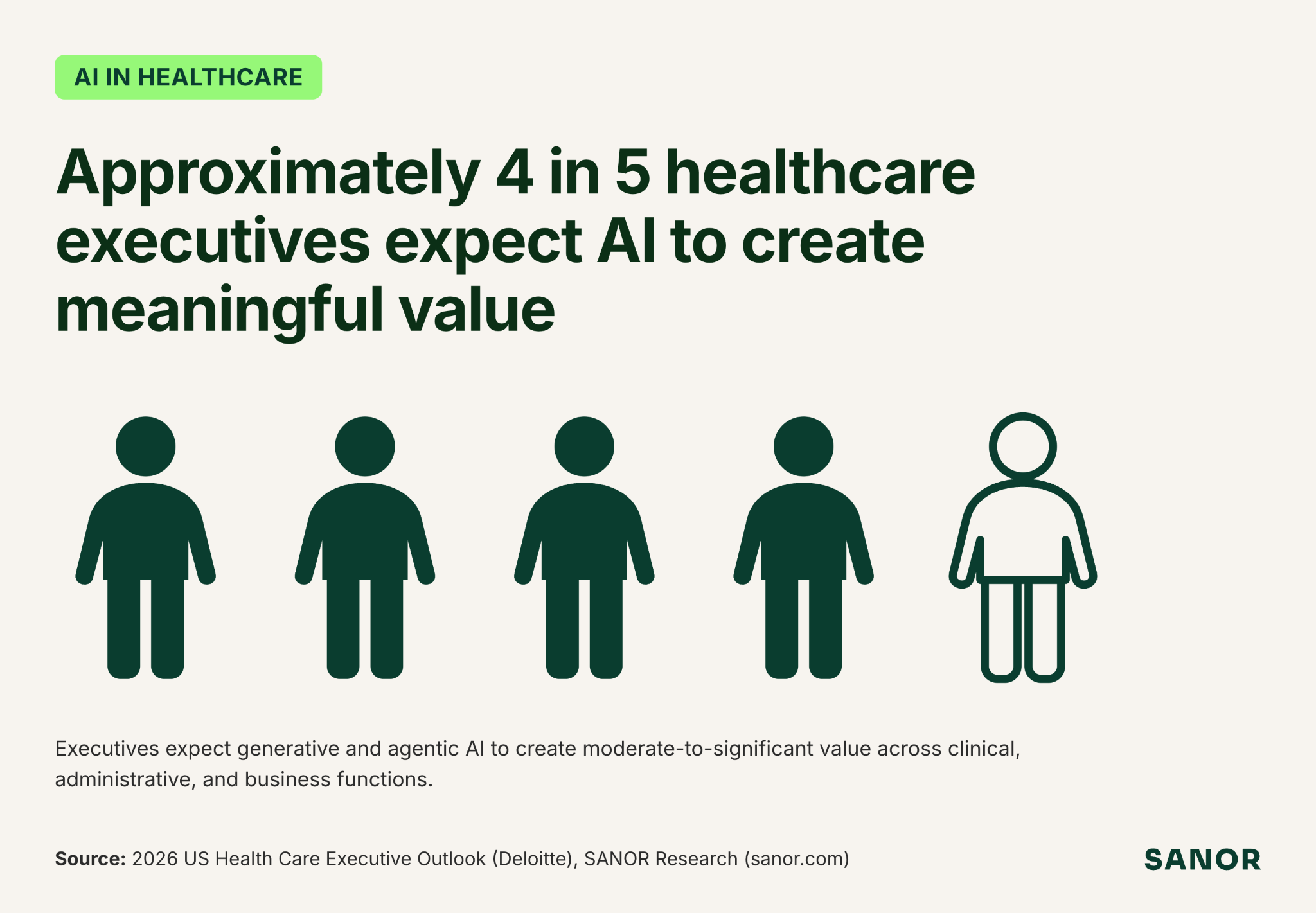
More than 80% of healthcare executives expect AI to create meaningful value (Deloitte)
One-third of healthcare AI initiatives have scaled across multiple functions (Deloitte)
Another third remained in pilot or limited use.
Roughly one-third had been paused or abandoned.
33% of healthcare organizations pursuing generative AI are taking a “buy” strategy (McKinsey)
That is up from 19% one year earlier.
More healthcare organizations are considering ready-made AI products instead of building their own systems internally.
Miscellaneous AI in Healthcare Statistics
FDA authorized 258 AI-enabled medical devices in 2025 (Stanford AI Index)
The number of AI-enabled medical devices continues to increase.
Many of these products are designed for medical imaging and other specialized clinical applications.
Around 76% of FDA-authorized AI medical devices are in radiology (Stanford HAI)
Radiology is by far the largest category of regulated medical AI.
AI tools have been used in imaging for longer than many newer generative AI applications.
34% of U.S. adults have used an AI chatbot for a health-related purpose (Pew Research Center)
28% have used one to quickly find health information.
25% have used one to investigate symptoms, while 20% have used one to help understand lab results.
22% of Americans use AI chatbots to learn about treatments (Pew Research Center)
The same percentage use them to learn more about a diagnosis received from a doctor.
Another 22% use AI because it can provide health information at little or no cost.
Only 16% of Americans say a healthcare provider has used AI in their care (Pew Research Center)
46% said they were not sure whether AI had been used.
That uncertainty may become more important as AI is built directly into EHRs and other systems patients do not necessarily see.
53% of Americans feel they have little or no say over whether providers use AI (Pew Research Center)
63% said they would like more say over how AI is used in their healthcare.
72% also said it was very or extremely important for providers to tell them when AI is being used.
Sanor publishes for general information. This publication is not medical, financial, or investment advice.
The Private Clinic Playbook
Grow revenue at each location and build a commercial model that can scale across a clinic group.
Sanor never sells your personal information. By providing this information you agree to Sanor’s Privacy Policy and Terms of Service.

SANOR research follows the principles of ISO 20252:2019 and the ICC/ESOMAR International Code on Market, Opinion and Social Research and Data Analytics, and is conducted in line with our Independence Policy. Our published reports follow our Editorial Standards.
SANOR research is funded through advisory engagements and research licensing. We do not accept vendor sponsorship, paid placement, or advertising.
All publications are provided for general information only. They do not constitute medical, financial, or investment advice and do not account for the circumstances of any specific business or individual.