The Billion-Dollar Race for a Totally Implantable Cochlear Implant
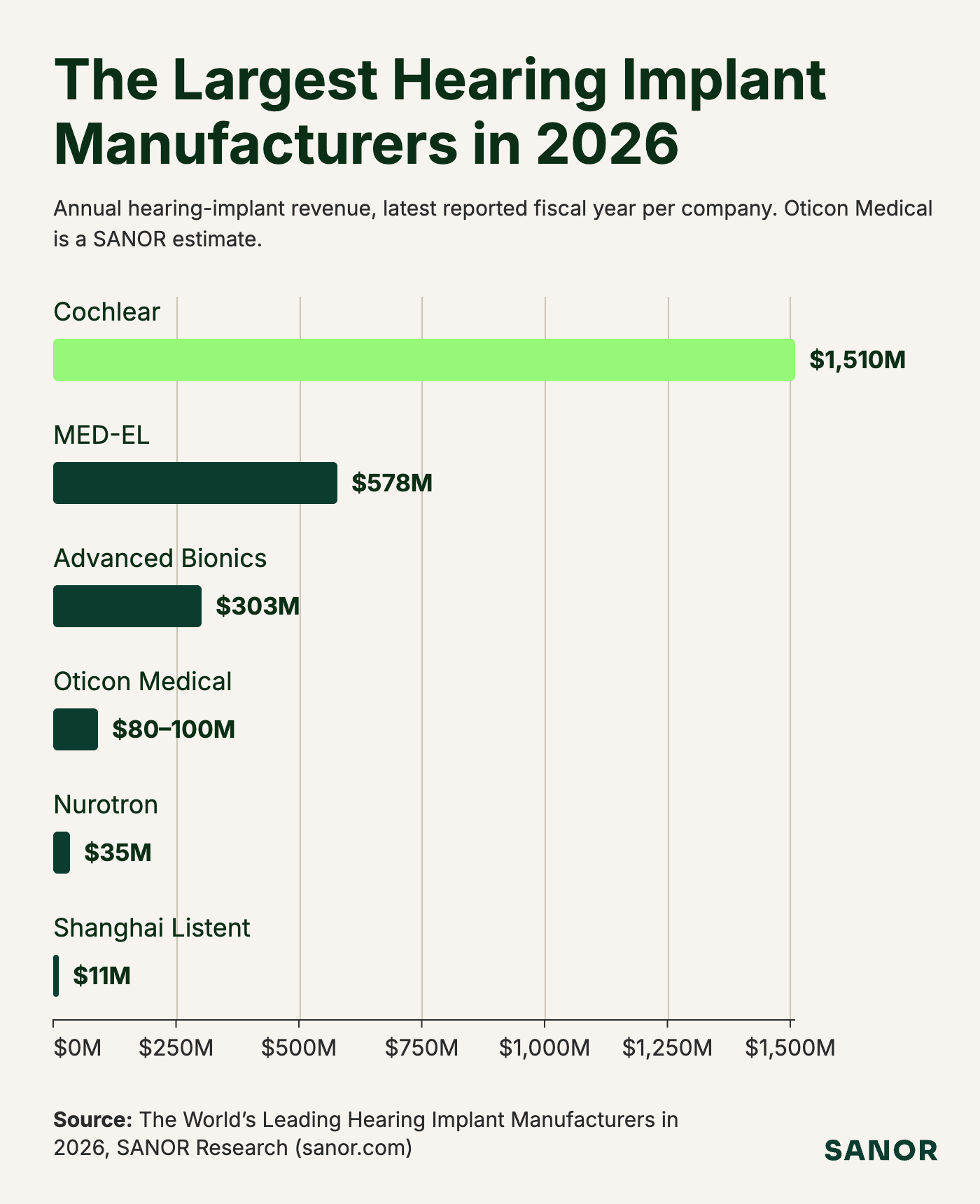
Cochlear has spent many years establishing itself in the leading position among hearing implant providers. Its revenue is more than two and a half times that of MED-EL, the next-largest company in the space.
Yet a new technology may offer Cochlear’s smaller rivals an opportunity to challenge the company. MED-EL, Envoy Medical, and Cochlear are all developing totally implantable cochlear implants, or TICIs. A TICI would provide hearing assistance without any external sound processor.
Currently, there is no commercial TICI product on the market. Cochlear’s competitors are working to be the first to roll one out. Cochlear, in turn, wants to prevent competitors from undermining its market leadership. If MED-EL or Envoy can roll out an effective TICI product before Cochlear does, it could also capture a bigger piece of the current cochlear implant market.
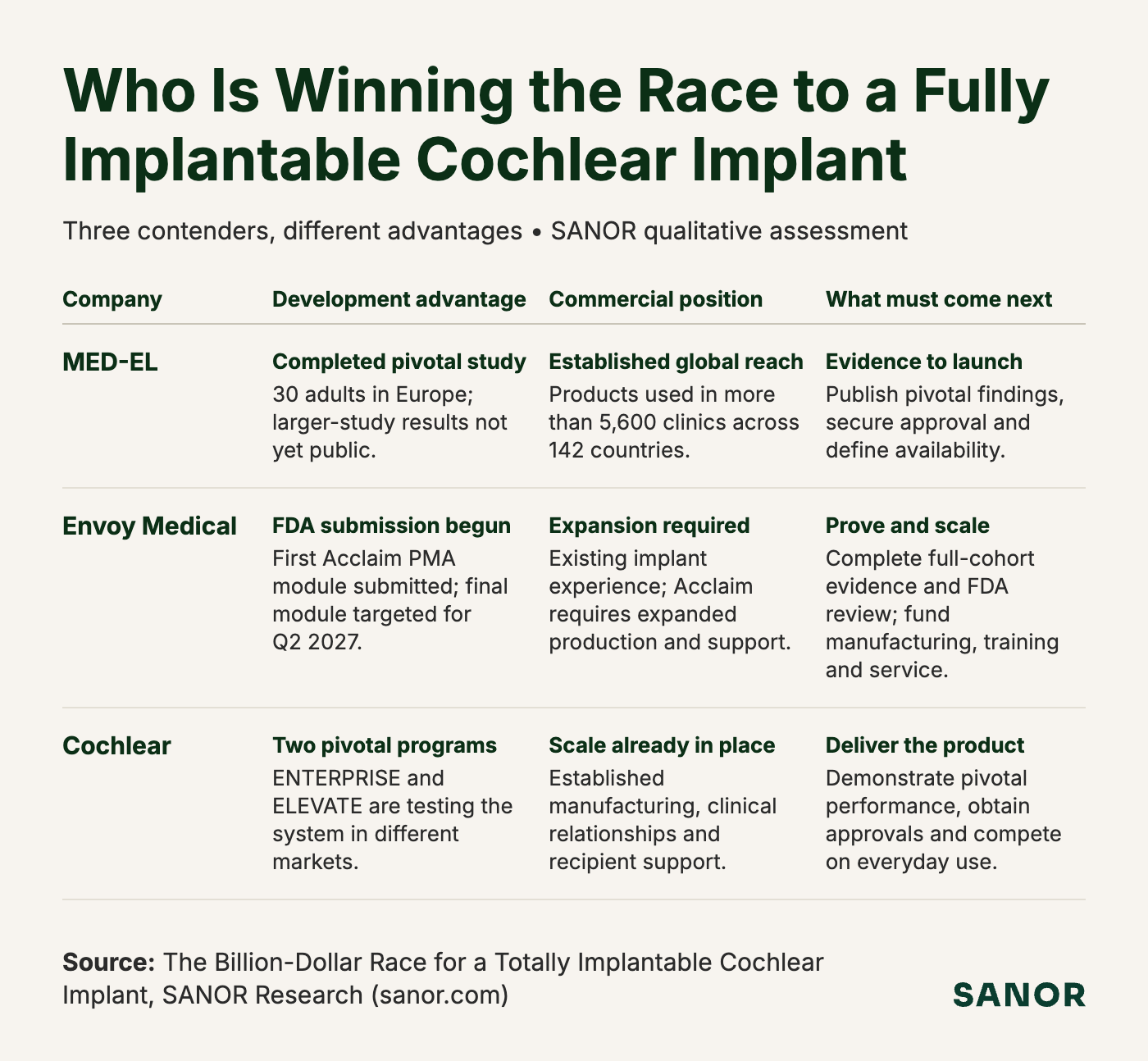
MED-EL has already completed its pivotal trial in Europe. Envoy has finished enrolling patients in its U.S. pivotal trial and has started its filing process with the FDA. Cochlear is presently conducting pivotal trials in Australia, France and the U.S.
Why Totally Implantable Implants Matter
Traditional cochlear implants have an electrode and receiver placed inside the user’s body. However, they still require an external microphone and processor. These must be removed when showering, swimming and often sleeping.
By moving these components inside the body, TICI technology would allow users to hear even while sleeping, showering or swimming, with no externally visible devices, depending on the eventual product and approved uses.
The concept is simple enough. But implementation has been challenging, and it has taken many years to bring to fruition.
A variety of elements must be addressed when a microphone is implanted under the skin:
- It must pick up speech through skin and tissue while filtering out sounds from breathing, chewing and movement.
- Power must be available to run the system all day. The battery must be safely rechargeable through the skin and last for many years.
- An external processor that fails is relatively easy to replace. Implanted devices that fail may require another procedure.
Not only must the device provide good hearing, but it must do so for many years.
MED-EL: First to Complete Its Pivotal Study
MED-EL has arguably produced the strongest published evidence so far that a fully implanted system can deliver hearing comparable with a conventional cochlear implant.
Its first human study implanted six adults with its Mi2000 TICI product beginning in 2020. Participants were followed for 52 weeks and tested both with the implanted microphone and processor and with an external MED-EL processor connected to the same implant, comparing the results.
The peer-reviewed feasibility study found that speech performance in quiet and noise was broadly comparable between the two configurations. Five of the six participants used the completely implanted mode for the majority of their listening time. One participant experienced swelling and apparent infection at the implant site, which was successfully treated.
Although these results are encouraging, the study had only six patients — too few to evaluate the safety and longevity of this new implant.
MED-EL has since moved to a pivotal study. Its pivotal Mi2000 study enrolled 30 hearing-impaired adults across Europe and tested how well patients wearing implants could recognize words six months after being fitted compared to their pre-op results.
The study, the most mature pivotal study on the topic so far, was completed in September 2025. As of September 2026, results had not been posted publicly.
If the results are strong, MED-EL has the infrastructure to compete. The privately owned Austrian manufacturer says its products are used by more than 5,600 clinics across 142 countries and that it invests 15-20% of turnover in research and development, according to its company profile.
A successful TICI would give an established global manufacturer a potentially important new way to take share from Cochlear.
Envoy: The Highest-Risk Attempt to Break into the Market
Envoy Medical is making the larger bet. The company’s SEC filings describe Acclaim as its principal development opportunity, meaning success or delay carries far greater consequences for Envoy than for either MED-EL or Cochlear.
Acclaim takes a different approach to the implanted-microphone problem. Instead of placing a conventional microphone under the skin, it uses a piezoelectric sensor attached to the middle ear.
It is designed to use the body’s innate mechanism for capturing sound. The sensor is similar to the one Envoy used in its Esteem middle-ear implant.
That could help avoid some of the acoustic problems associated with subcutaneous microphones, but it introduces its own mechanical and surgical requirements.
Envoy’s product features replaceable batteries with an estimated lifespan of eight to 12 years, according to its SEC filings. However, that figure is still only a design expectation. The company has not yet demonstrated this capability in a clinical setting.
In March 2026, Envoy finished enrolling its pivotal U.S. study of 56 patients. Patients are being assessed for word recognition 12 months after implantation compared to their baseline aided hearing prior to surgery.
Among the first 10 participants to reach 12 months, mean CNC (consonant-nucleus-consonant) word-recognition scores increased from 15.2% before implantation to 53.2% at 12 months, according to the company. That was also an improvement from a mean 39.2% at six months. Envoy reported the 12-month data in July 2026.
However, 10 patients are less than one-fifth of the pivotal study group. These are preliminary company findings, not the final trial results.
Still, Envoy is the furthest along of the three on a publicly disclosed U.S. regulatory pathway toward FDA approval. The first of its four planned PMA (premarket approval) modules was sent to the FDA in 2026. Submission of the fourth module, containing all final trial data, is expected in the second quarter of 2027.
Acclaim has also received FDA Breakthrough Device designation, which can enable closer interaction with the regulator but does not lower the standard required for approval. Envoy detailed its PMA progress in its second-quarter 2026 update.
Approval would also create an entirely new set of challenges for the company: Envoy does its final assembly in Minnesota, but it depends on external companies for many critical subcomponents, some of which have only a single supplier, according to the company’s 2025 annual report.
This could make it difficult for Envoy to scale Acclaim up to full production. It would have to build much of the production and commercial infrastructure that its competitors already possess.
Cochlear Is Now Closing the Gap
As the largest and most established of the three competing companies, Cochlear’s situation is more defensive: It does not need TICI to create a cochlear implant business. It needs TICI to protect the business and market share it already has.
Its scale gives Cochlear substantial advantages in production, regulatory affairs, surgical training, fitting software, clinical relationships and long-term recipient support.
Until recently Cochlear’s TICI program appeared to trail its competitors on some key clinical milestones.
But that gap is narrowing. Cochlear now has two pivotal studies underway and a smaller supporting study.
Cochlear’s ENTERPRISE pivotal study is testing a totally implantable system in 36 adults in Australia and France. The study is active but no longer recruiting.
More significantly, Cochlear began a separate U.S. pivotal study called ELEVATE in April 2026. ELEVATE plans to enroll 56 adults across 11 U.S. sites and is testing Cochlear’s TI1132 implant. Primary completion is currently expected in October 2027.
The investigational system uses an implanted microphone beneath the skin, allowing patients to hear without an external processor.
Cochlear is also running the smaller ENHANCE study, focused specifically on implanted-microphone performance and signal processing.
The implanted microphone is one of the toughest engineering hurdles to overcome. Cochlear’s own earlier research found that bodily sounds such as breathing and swallowing could interfere with usable sound. Cochlear’s continued focus on how the microphone behaves after implantation suggests the company still treats this as a significant hurdle.
The company may therefore arrive later than Envoy in the U.S. regulatory process. But unlike Envoy, Cochlear can afford to: Even if one of its rivals rolls out their TICI solution first, Cochlear could still bring its own device to market, and sell it through its own pre-existing global commercial system.
Why Being First May Not Be Enough
Displacing traditional implant technology, even with a better alternative, isn’t like getting people to switch phone plans or even hearing aids. There are significant barriers to entry.
For example, surgeons become comfortable with a certain electrode array and system. Audiologists are already trained on a manufacturer’s platform. Many clinics have already built their entire process and workflow around one manufacturer.
Recipients may depend on a manufacturer for processor upgrades, software and servicing for decades. Even if a smaller company were to gain approval and field a better product, it may be difficult to get providers to disrupt their business models to make the switch.
TICI adds further considerations:
- Patients with conventional implants and external processors can easily upgrade to a new processor today, just by swapping the component. A totally implantable device will need some other method for upgrading that does not require repeated surgery.
- Internal batteries will age, and replacing them requires a procedure.
- Microphones or sensors must keep functioning even as tissue grows around them.
This situation naturally favors companies with a long track record of dependable implants and a well-developed service network. But it also allows challengers to enter the fray if their technology is notably superior.
For Envoy, an approved system that eliminates the conventional implanted microphone could provide a clear point of differentiation. For MED-EL, strong pivotal results combined with its existing global footprint could make TICI a more credible competitive weapon than a conventional product refresh.
The Bigger Prize Is Market Share
There is no billion-dollar TICI market today. There are no approved products. The billion-dollar opportunity comes from the cochlear implant market the technology could reshape.
Cochlear alone generated A$2.34 billion (≈ US$1.51 billion) in FY2026 revenue across its hearing-implant systems, products and services, according to its FY2026 results.
If TICI becomes an important product category, the first effect could simply be redistribution. Patients who would otherwise have received a traditional cochlear implant may choose MED-EL or Envoy instead of Cochlear because they prefer a totally implantable system. That is, TICI technology mostly replaces the older technology, but does not reach any big new customer segments.
The more ambitious possibility is that TICI expands the entire implant market itself.
Many more people could benefit from cochlear implants than currently use them. The authors of MED-EL’s feasibility study note that tens of millions of people worldwide have severe-to-profound hearing loss, but only a small fraction of them have received implants.
A totally implantable system isn’t enough to bridge that gap on its own. The process involves surgery, cost and reimbursement, patient education, and suitability assessments.
But if a TICI can eliminate visible external hardware, require less daily upkeep, and provide uninterrupted hearing, it might encourage more people to opt for implantation.
If that occurs, the competition will escalate beyond poaching patients from Cochlear. The companies will be competing to expand the overall market.
Who Is Ahead?
Right now, there is no single leader across every measure.
MED-EL has conducted the most advanced pivotal trial, but has not released its data yet.
Envoy is furthest ahead on the path to FDA approval in the U.S., and stands to benefit the most from being first to market. But it still has to prove its results across the full cohort, and then build a commercial organization capable of competing with much larger manufacturers.
Cochlear is behind on the U.S. front, but its new ELEVATE study shows it is catching up. If Cochlear’s product proves competitive, its established manufacturing scale and extensive clinic and support infrastructure would be difficult for any competitor to overcome.
A lot rides on who receives approval first. If MED-EL or Envoy get approval first, they may enjoy a temporary advantage with no direct competition from Cochlear. But what happens after that remains to be seen: Even if Cochlear receives approval much later than either or both of its competitors, its pre-existing distribution system is a powerful asset, and may be tough for the smaller companies to overcome.
The real test will be whether the first company to win approval can turn that lead into enough surgeon and patient adoption to gain market share before Cochlear’s competitive entry.
That is where the billion-dollar race will actually be won.
Next read: The World’s Leading Hearing Implant Manufacturers in 2026
Sanor publishes for general information. This publication is not medical, financial, or investment advice.
The Private Clinic Playbook
Grow revenue at each location and build a commercial model that can scale across a clinic group.
Sanor never sells your personal information. By providing this information you agree to Sanor’s Privacy Policy and Terms of Service.

SANOR research follows the principles of ISO 20252:2019 and the ICC/ESOMAR International Code on Market, Opinion and Social Research and Data Analytics, and is conducted in line with our Independence Policy. Our published reports follow our Editorial Standards.
SANOR research is funded through advisory engagements and research licensing. We do not accept vendor sponsorship, paid placement, or advertising.
All publications are provided for general information only. They do not constitute medical, financial, or investment advice and do not account for the circumstances of any specific business or individual.