The 10 Largest Clinical Software Companies in 2026
Clinical software is winning major hospital contracts and attracting hundreds of millions in investment.
For example, Australia-based Pro Medicus recently closed on A$407 million worth of new contracts for its recently concluded FY2026. And San Francisco, California-based Heartflow, a company that makes cardiology diagnostic technology, raised around US$364 million in its 2025 initial public offering.
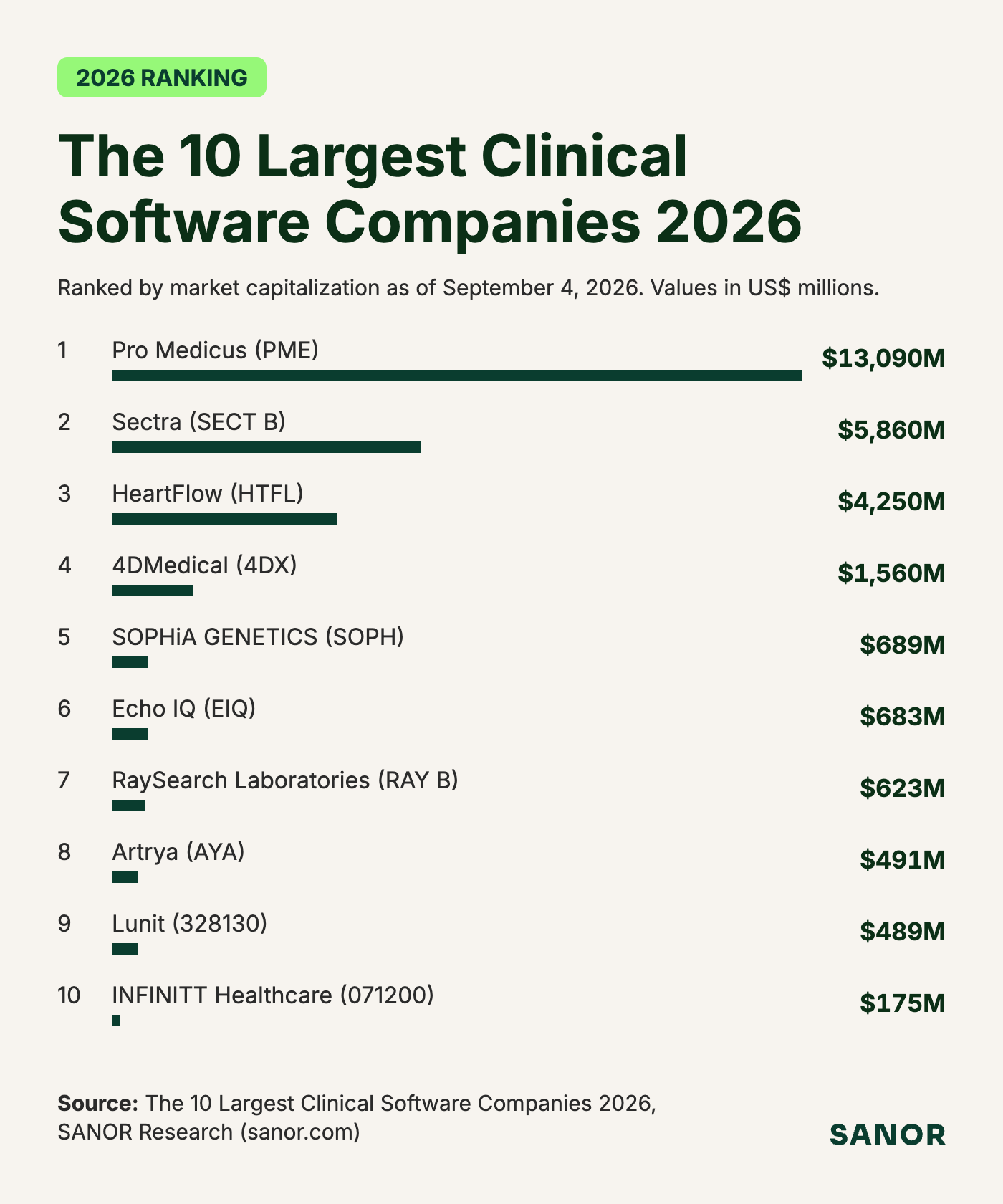
This report ranks the 10 largest clinical software companies measured by market cap in U.S. dollars.
For the purposes of this study, we defined a clinical software company as one that mainly develops or sells software to diagnose, treat, or monitor patients in a clinical setting. Diversified companies or conglomerates qualify if clinical software represents more than 50% of company revenue.
Executive Summary
- The field is highly concentrated: Melbourne, Australia-based Pro Medicus is by far the largest by market capitalization at US$13 billion – more than double the size of Sweden-based runner-up Sectra, with a market capitalization of US$5.9 billion.
- The two biggest companies both focus on enterprise imaging. The rest of the list spans cardiovascular diagnostics, lung and respiratory analysis, genomic medicine, radiation-oncology planning, and cancer detection AI.
- The smallest company in the top 10 is a Korean firm, INFINITT Healthcare, with a market cap of US$175 million.
1. Pro Medicus (PME)

- Founded: 1983
- Headquarters: Melbourne, Australia
- CEO: Dr. Sam Hupert
- Primary Software: Visage 7 Enterprise Imaging Platform
- Market Cap: $13.09 billion (September 4, 2026)
- Revenue: A$261.7 million (FY2026)
- Revenue Growth: 22.9% YoY
- Number of Employees: 153
What they do
Pro Medicus provides enterprise medical imaging solutions to hospital and imaging companies worldwide.
Their flagship product is Visage Imaging, which combines a cloud-based picture archiving and communication system (PACS) with a set of visualization, workflow and AI tools for use in radiology and other imaging-intensive medical fields.
The company recently signed nine new contracts in North America, one in Europe, and had six existing customers renew their contracts.
As of June 30, 2026, Pro Medicus had A$1.3 billion in minimum contracted revenue locked for the following five years — an improvement of 41% over their FY2025 numbers. The company remains debt free, while continuing to expand their enterprise imaging business.
2. Sectra (SECT B)

- Founded: 1978
- Headquarters: Linköping, Sweden
- CEO: Torbjörn Kronander
- Primary Software: Sectra Enterprise Imaging
- Market Cap: $5.86 billion (September 4, 2026)
- Revenue: SEK 3.54 billion (FY2025/26)
- Revenue Growth: 9.3% YoY
- Number of Employees: Approximately 1,100
What they do
Swedish firm Sectra develops medical imaging IT for radiology, cardiology, pathology, orthopedics, ophthalmology, and genomics.
Specifically, Sectra’s platform allows hospitals and health systems to view and manage images, archives, workflows, and other pertinent clinical data.
More than 2,500 sites worldwide use Sectra’s imaging solutions, handling an estimated 170 million exams each year.
Some 70% of group sales are recurring.
Cloud recurring revenue grew by 54.9% to SEK 915.8 million as they continue to migrate customers to their cloud delivery solution.
Sectra also received seven Best in KLAS awards in 2026.
3. Heartflow (HTFL)

- Founded: 2007
- Headquarters: San Francisco, California
- CEO: John Farquhar
- Primary Software: Heartflow Platform
- Market Cap: US$4.25 billion (September 4, 2026)
- Revenue: $176.0 million (FY2025)
- Revenue Growth: 39.9% YoY
- Number of Employees: 843
What they do
Heartflow uses artificial intelligence to help analyze coronary artery disease.
The company’s flagship product, Heartflow FFRCT Analysis (fractional flow reserve computed from CT) analyzes data from coronary CT angiography and creates a 3D image of the patient’s coronary arteries. While it’s just one of three products in the Heartflow Platform, alongside Plaque Analysis and RoadMap Analysis, the FFRCT solution generated 98% of Heartflow’s revenues last year.
As of the end of FY2025, the Heartflow Platform has analyzed over 600,000 patients, total, with 219,000 in 2025 alone.
4. 4DMedical (4DX)

- Founded: 2012
- Headquarters: Melbourne, Australia
- CEO: Dr. Andreas Fouras
- Primary Software: CT:VQ, XV LVAS and lung imaging analytics
- Market Cap: US$1.56 billion (September 4, 2026)
- Revenue: A$7.06 million (FY2026)
- Revenue Growth: 20.6% YoY
- Number of Employees: 124 (FY2025)
What they do
4DMedical creates software that measures respiratory function, including ventilation and perfusion, to help detect pulmonary diseases.
Key products include CT:VQ, XV Lung Ventilation Analysis Software, and CT LVAS.
Notable transactions
On August 17, 2026, 4DMedical announced an OEM and reseller partnership agreement with Azra AI to improve patient identification and clinical follow-up on lung scan patients. The company will be reselling the Azra patient identification product, and will be integrating their own products such as CT:VQ into the platform as well.
This allows 4DMedical to not only provide analysis of scans but also help physicians track their patients from incidental findings all the way through to specialist care.
5. SOPHiA GENETICS (SOPH)

- Founded: 2011
- Headquarters: Rolle, Switzerland
- CEO: Ross Muken
- Primary Software: SOPHiA DDM
- Market Cap: US$688.68 million (September 4, 2026)
- Revenue: $77.3 million (FY2025)
- Revenue Growth: 19% YoY
- Number of Employees: 415 FTE (year-end 2025)
What they do
SOPHiA GENETICS develops cloud-based software that analyzes genomic and radiomic data alongside other multimodal medical inputs. Hospitals, clinical laboratories, biopharmaceutical companies, and other life-science organizations run its SOPHiA DDM platform to interpret complex patient data for precision medicine, from oncology to inherited disorders.
The company has over 540 core genomics customers and is adding more across multiple fields.
They also ran a record 115,000 analyses on the SOPHiA DDM platform in Q2 2026 up 22% year over year.
Notable transactions
In August 2026, SOPHiA GENETICS secured a multi-year collaboration agreement with AstraZeneca for two companion diagnostic initiatives covering solid tumors and blood cancers.
6. Echo IQ (EIQ)

- Founded: 2010
- Headquarters: Sydney, Australia
- CEO: Dustin Haines
- Primary Software: EchoSolv
- Market Cap: US$682.98 million (September 4, 2026)
- Revenue: A$91,646 (FY2026)
- Revenue Growth: -9.6% YoY
- Number of Employees: 11–50 (LinkedIn company-size range; accessed September 14, 2026)
What they do
Sydney, Australia-based Echo IQ builds software products for cardiologists that use AI to help detect certain structural abnormalities of the heart. Their lead product, EchoSolv AS, extracts measurements from an echocardiogram, and automatically alerts the cardiologist if it detects severe aortic stenosis. The product received FDA 510(k) clearance as a Class II medical device in late 2024.
A second solution, EchoSolv HF (heart failure), addresses a potentially bigger market, but remained under FDA review as of its July 2026 quarterly report. Echo IQ has also signed an agreement with Mayo Clinic to distribute EchoSolv HF once the FDA clears it.
Revenue for FY2026 came in at A$91,646, down roughly 9.6% from A$101,409 the prior year.
Notable transactions
On July 1, Echo IQ locked in firm commitments for roughly A$110 million in equity, issuing 75,862,069 new shares at A$1.45 each. The price was an 8.8% discount to the last close (June 26).
The placement is separate from a binding heads of agreement — a document that sets out a deal’s key terms — that Echo IQ signed with Pro Medicus in June 2026. It covers up to A$20 million in secured convertible notes: an initial A$10 million and a further A$10 million subject to FDA clearance of EchoSolv HF. It also proposes a partnership under which Pro Medicus would resell EchoSolv in the U.S., which was still being documented as of Echo IQ’s July 2026 quarterly report.
At June 30, 2026, before the placement settled, Echo IQ held A$8.7 million in cash and had no undrawn financing facilities, according to its July 2026 quarterly report.
7. RaySearch Laboratories (RAY B)

- Founded: 2000
- Headquarters: Stockholm, Sweden
- CEO: Johan Löf
- Primary Software: RayStation and RayCare
- Market Cap: US$622.95 million (September 4, 2026)
- Revenue: SEK 1.34 billion (FY2025)
- Revenue Growth: 13% YoY
- Number of Employees: Approximately 460
What they do
Stockholm-based RaySearch Laboratories creates software solutions widely used in oncology and cancer treatment. Offerings include RayStation, a treatment planning platform, RayCare for oncology information management, RayIntelligence for clinical analytics, and RayCommand to manage treatment control workflows.
RayStation, which accounts for the bulk of the company’s revenue, is currently implemented in around 1,200 cancer facilities around the world.
The company ended the year with an order backlog of SEK 1.53 billion, and operating profit rose 12% to SEK 292 million.
8. Artrya (AYA)

- Founded: 2019
- Headquarters: Perth, Australia
- CEO: John Konstantopoulos
- Primary Software: Salix Coronary Platform
- Market Cap: US$490.69 million (September 4, 2026)
- Revenue: A$28,000 (FY2026)
- Revenue Growth: 0% YoY (reported)
- Number of Employees: Approximately 59 (LeadIQ estimate, July 2026)
What they do
Artrya develops AI-powered cardiovascular software for diagnosing and managing coronary artery disease. Its Salix platform analyzes coronary CT angiography and assesses coronary anatomy and plaque. More software products are in development to evaluate coronary blood flow.
Artrya’s 2026 annual report describes the commercial rollout of Salix at three U.S. foundation customers: Tanner Health, Cone Health, and Northeast Georgia Health System. Its SAPPHIRE study began in July 2026 and brought together six U.S. health systems to test whether Salix plaque analysis can help predict cardiovascular events. That gives Artrya an evidence program running alongside its early commercial deployments. Reported FY2026 revenue was A$28,000. SaaS revenue before a non-cash customer-option adjustment was A$177,000.
9. Lunit (328130)

- Founded: 2013
- Headquarters: Seoul, South Korea
- CEO: Brandon Beomseok Suh
- Primary Software: Lunit INSIGHT and Lunit SCOPE
- Market Cap: US$489.09 million (September 4, 2026)
- Revenue: KRW 83.1 billion (FY2025)
- Revenue Growth: 53% YoY
- Number of Employees: 272 (parent company, year-end 2025)
What they do
Lunit develops AI-enhanced software focused primarily on cancer detection and treatment. Lunit INSIGHT reads medical images for cancer screening and diagnosis. Lunit SCOPE analyzes biomarkers to support precision oncology and cancer-treatment decisions.
Though the company is based in Korea, international sales account for about 92% of revenue. Lunit SCOPE sales increased 159% in 2025.
Notable transactions
Lunit purchased breast cancer imaging and screening technology company Volpara Health Technologies in 2024 in a deal worth about A$292 million to access the U.S. market.
In November 2025, Lunit rebranded Volpara as Lunit International. The unit covers the former Volpara operations and leads Lunit’s commercial activity in the U.S. and other international markets, while the Seoul headquarters focuses on research and development.
Lunit continues to integrate the former Volpara operations and expand its breast cancer screening and diagnostic portfolio.
10. INFINITT Healthcare (071200)

- Founded: 2002
- Headquarters: Seoul, South Korea
- Co-CEOs: Hong Ki-tae and Lee Won-yong
- Primary Software: INFINITT PACS, VNA and Enterprise Imaging
- Market Cap: US$174.77 million (September 4, 2026)
- Revenue: KRW 102.39 billion (FY2025)
- Revenue Growth: 6.9% YoY
- Number of Employees: 246
What they do
Korea-based INFINITT Healthcare creates imaging and information management software used by hospitals and diagnostic companies.
They offer PACS, vendor-neutral archiving, enterprise image viewers, radiology reporting and cloud imaging solutions used to store medical images and associated data.
In June 2026, INFINITT North America went live with its ophthalmology image-management system at West Virginia University Hospital, integrated with Epic Kaleidoscope. In August, it announced an ongoing digital-pathology project with Oswego Health that digitizes the hospital’s pathology lab, enabling physicians to review cases remotely and collaborate with outside specialists.
Conclusion
Enterprise imaging occupies the top two positions, while cardiovascular diagnostics, precision medicine, and other specialist applications account for much of the rest of the ranking. Recent hospital deployments and partnerships show these companies expanding where their software is used. Their commercial maturity varies considerably, however: Established platforms sit alongside developers only beginning to generate recurring revenue. Market capitalization captures that mix of current scale and investor expectations.
To learn more about medical technology, check out our ranking of the top 20 medical technology companies in 2026.
Ranking note:
We ranked companies by market capitalization — share price multiplied by shares outstanding — in U.S. dollars as of September 4, 2026. Revenue appears in each company’s reporting currency for its most recent fiscal year, as labeled in each profile. Employee counts come from company reports where available; the Echo IQ figure is a LinkedIn company-size range and the Artrya figure is a LeadIQ estimate.
Sanor publishes for general information. This publication is not medical, financial, or investment advice.
The Private Clinic Playbook
Grow revenue at each location and build a commercial model that can scale across a clinic group.
Sanor never sells your personal information. By providing this information you agree to Sanor’s Privacy Policy and Terms of Service.

SANOR research follows the principles of ISO 20252:2019 and the ICC/ESOMAR International Code on Market, Opinion and Social Research and Data Analytics, and is conducted in line with our Independence Policy. Our published reports follow our Editorial Standards.
SANOR research is funded through advisory engagements and research licensing. We do not accept vendor sponsorship, paid placement, or advertising.
All publications are provided for general information only. They do not constitute medical, financial, or investment advice and do not account for the circumstances of any specific business or individual.