The 20 Largest Medical Technology Companies in 2026
Global medtech revenue is projected to reach about $666 billion in 2026, up 5.4% from 2025.
This ranking covers the 20 largest publicly traded companies in that market, ordered by market capitalization as of September 4, 2026, calculated from exchange prices and company filings. SANOR counts a company as medical technology when more than 50% of its revenue comes from medical devices, diagnostics, equipment or software used directly to prevent, diagnose, monitor or treat medical conditions.
Executive Summary
- The 20 largest publicly traded medical technology companies represent about $1.11 trillion in market value as of Sept. 4, 2026. The four largest, led by Abbott at $187.45 billion, hold close to half of that.
- Smaller companies are growing faster than larger ones — Natera at 35.9%, Boston Scientific at 19.9%, Dexcom at 16% — while most of the largest posted single-digit growth. Intuitive Surgical, second by market cap, was the exception at 20.5%; Mindray was the only company whose revenue fell.
- The group’s combined market value ended 2025 just 1.3% below its 2021 peak, but three companies — Intuitive Surgical, Boston Scientific and Natera — drove nearly all of the recovery. Without them, the other 16 were still down 18.2%.
The detailed ranking and company profiles follow the graphic below.
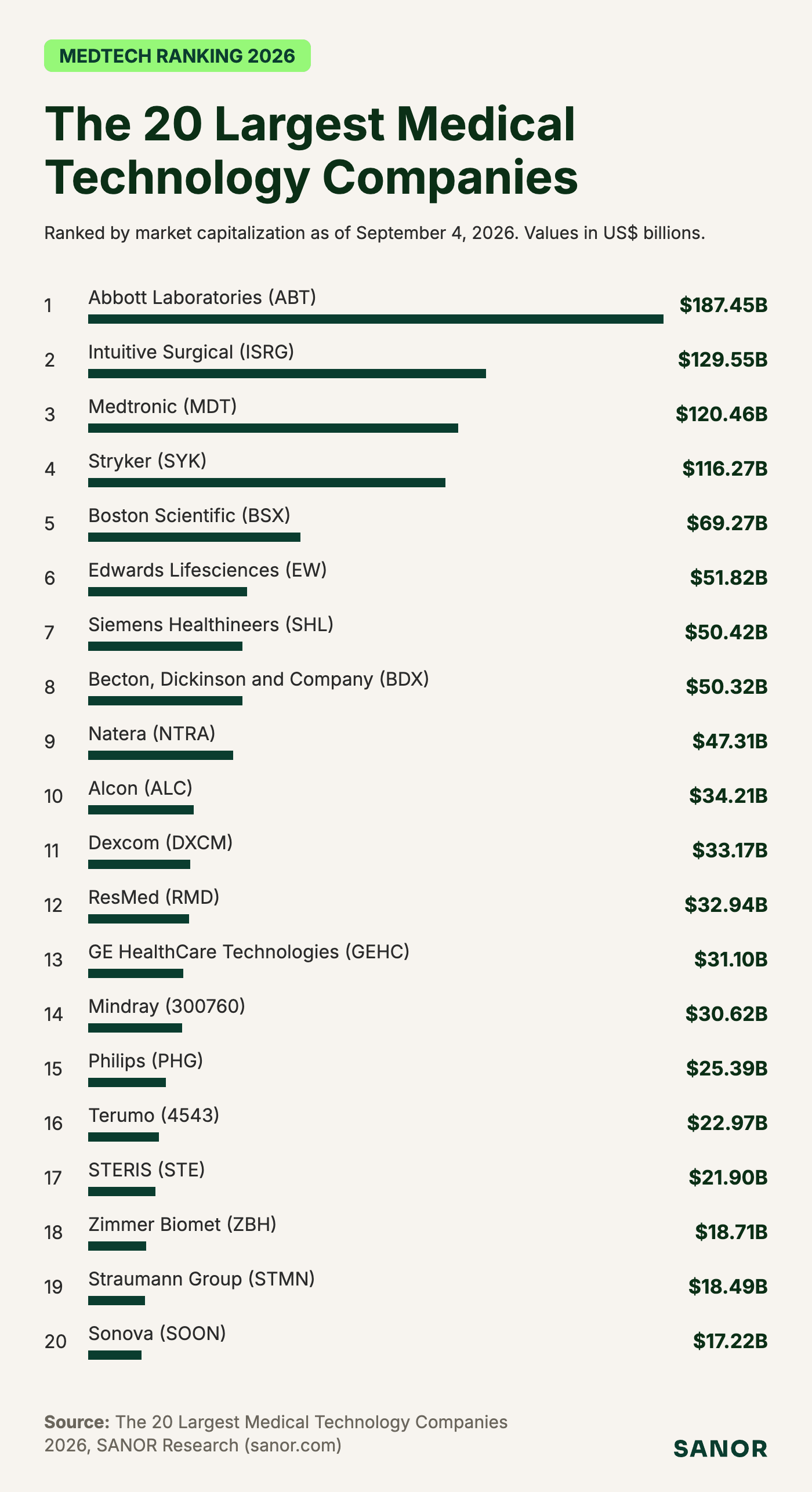
Here’s a closer look at each of these 20 companies, one-by-one:
1. Abbott Laboratories (ABT)

- Founded: 1888
- Headquarters: Abbott Park, Illinois
- CEO: Robert B. Ford
- MedTech Category: Diversified Medical Devices & Diagnostics
- Market Cap: $187.45 billion (September 4, 2026)
- Revenue: $44.3 billion (FY2025)
- Revenue Growth: 5.7% YoY (reported)
- Number of Employees: Approximately 115,000
What They Do
Abbott sells a wide variety of products from medical devices to diagnostics, nutrition and pharmaceuticals. Its portfolio includes widely used products such as FreeStyle Libre, a continuous glucose monitor. It also develops cardiovascular technology used in electrophysiology, and treating or preventing arrhythmia and heart failure.
Medical devices is Abbott’s largest division, with revenues growing 11.9% on a currency neutral basis in 2025. Meanwhile, Abbott’s Glucose Monitoring division, including FreeStyle Libre, generated $7.6 billion in 2025, up strongly from $6.4 billion the year before.
Notable Transactions
In March of 2026 Abbott acquired Exact Sciences for approximately $21 billion. This strategic acquisition added Cologuard, Oncotype DX, Cancerguard and more to Abbott’s product line.
In the second quarter of 2026, Abbott reported another $12.6 billion in sales, and maintained full-year growth guidance of 6.5% to 7.5%.
2. Intuitive Surgical (ISRG)

- Founded: 1995
- Headquarters: Sunnyvale, California
- CEO: David J. Rosa
- MedTech Category: Surgical Robotics
- Market Cap: $129.55 billion (September 4, 2026)
- Revenue: $10.06 billion (FY2025)
- Revenue Growth: 20.5% YoY
- Number of Employees: Approximately 17,021
What They Do
Intuitive Surgical is most widely known for their robotics systems, including their da Vinci system — used in many different types of soft tissue surgeries — and the Ion, which allows physicians to perform minimally invasive lung biopsies. As of the end of 2025 there were over 11,000 da Vinci systems in operation worldwide.
Procedure volumes grew 15% year-over-year in Q2 2026 due to the widespread adoption of the da Vinci 5 system. Quarterly revenue increased 19% to $2.89B, following Intuitive’s first year with over $10 billion in sales.
3. Medtronic (MDT)

- Founded: 1949
- Headquarters: Galway, Ireland
- CEO: Geoffrey S. Martha
- MedTech Category: Diversified Medical Devices
- Market Cap: $120.46 billion (September 4, 2026)
- Revenue: $36.4 billion (FY2026)
- Revenue Growth: 8.4% YoY
- Number of Employees: 95,000+
What They Do
Medtronic’s business divisions include Cardiovascular Devices, Neuroscience, Diabetes & Monitoring, and Surgical Technology. They make products such as pacemakers and defibrillators, cardiac ablation products, insulin pumps, and develop neurostimulation and surgical technologies.
In December 2025, Medtronic received FDA clearance for its Hugo robotic-assisted surgery (RAS) system for urologic procedures, which allows surgeons to operate through tiny incisions by controlling robotic arms using 3D visualization technology.
Notable Transactions
Medtronic recently acquired CathWorks and has made more acquisitions in the neurovascular and neuromodulation space.
4. Stryker (SYK)

- Founded: 1941
- Headquarters: Portage, Michigan
- CEO: Kevin A. Lobo
- MedTech Category: Surgical Technology & Orthopedics
- Market Cap: $116.27 billion (September 4, 2026)
- Revenue: $25.12 billion (FY2025)
- Revenue Growth: 11.2% YoY
- Number of Employees: Approximately 56,000
What They Do
Stryker’s business lines include orthopedics, surgical technology, neurotechnology, emergency medicine, and interventional medicine. The company makes many joint replacement implant products.
Its flagship product is Mako, a robotic-assisted surgery system for orthopedics, and specifically for joint replacement procedures.
Notable Transactions
Stryker completed its roughly $4.9 billion acquisition of Inari Medical in 2025, adding the FlowTriever and ClotTriever peripheral vascular systems to its portfolio. In 2026, Stryker expanded its Mako franchise with the U.S. commercial launch of the Mako RPS handheld robotic system for total knee replacement. Organic sales increased by 10.3% in 2025 as annual revenue surpassed $25 billion for the first time.
5. Boston Scientific (BSX)

- Founded: 1979
- Headquarters: Marlborough, Massachusetts
- CEO: Michael F. Mahoney
- MedTech Category: Cardiovascular & Interventional Devices
- Market Cap: $69.27 billion (September 4, 2026)
- Revenue: $20.07 billion (FY2025)
- Revenue Growth: 19.9% YoY
- Number of Employees: Approximately 59,000
What They Do
Boston Scientific builds minimally invasive devices for cardiovascular care, electrophysiology, urology, endoscopy, neuromodulation, and other interventional specialties. Major products include the FARAPULSE pulsed field ablation system for atrial fibrillation, WATCHMAN left atrial appendage closure devices, coronary and peripheral vascular technologies, and a broad range of endoscopic and urological devices.
The company saw a 15.8% organic revenue increase in 2025.
Notable Transactions
Boston Scientific acquired Bolt Medical in 2025, which enabled the company to add SEISMIQ, an intravascular lithotripsy device for treating calcified peripheral arteries to complement their existing portfolio.
6. Edwards Lifesciences (EW)

- Founded: 1958
- Headquarters: Irvine, California
- CEO: Bernard Zovighian
- MedTech Category: Structural Heart Technology
- Market Cap: $51.82 billion (September 4, 2026)
- Revenue: $6.07 billion (FY2025)
- Revenue Growth: 11.5% YoY
- Number of Employees: Approximately 16,000
What They Do
Edwards Lifesciences specializes in technologies for structural heart disease. Its portfolio is centered on transcatheter aortic valve replacement (TAVR), which replaces the aortic valve through a catheter instead of open surgery, using the SAPIEN family of valves, along with transcatheter mitral and tricuspid repair and replacement technologies including PASCAL and EVOQUE.
TAVR remains Edwards’ core business, but its newer mitral and tricuspid technologies are becoming increasingly meaningful to its growth. In Q2 2026, TAVR revenue increased 11.3%, while transcatheter mitral and tricuspid therapy sales reached $195.9 million. Total quarterly sales rose 13.6% to $1.74 billion, and Edwards raised its 2026 constant-currency sales growth outlook to 10%–11%.
7. Siemens Healthineers (SHL)

- Founded: 2017
- Headquarters: Erlangen, Germany
- CEO: Bernd Montag
- MedTech Category: Medical Imaging & Diagnostics
- Market Cap: $50.42 billion (September 4, 2026)
- Revenue: €23.4 billion (FY2025)
- Revenue Growth: 5.9% YoY on a comparable basis
- Number of Employees: Approximately 74,000
What They Do
Siemens Healthineers operates across medical imaging, diagnostics, cancer care and minimally invasive treatment technologies. Its portfolio includes CT and MRI scanners, X-ray and molecular imaging systems, laboratory and point-of-care diagnostics, ultrasound, image-guided therapy systems, and radiation oncology technologies through Varian.
Imaging remains Siemens Healthineers’ largest and most profitable business, while Varian gives the company a substantial radiation oncology platform. In Q3 FY2026, the equipment book-to-bill ratio (new orders measured against sales) reached 1.27x, and Precision Therapy revenue grew 9.2%. Diagnostics revenue, in contrast, declined 5.5%, but total comparable company revenue increased by 2.8%, year over year.
8. Becton, Dickinson and Co. (BDX)

- Founded: 1897
- Headquarters: Franklin Lakes, New Jersey
- CEO: Tom Polen
- MedTech Category: Medical Devices & Connected Care
- Market Cap: $50.32 billion (September 4, 2026)
- Revenue: $21.84 billion (FY2025)
- Revenue Growth: 8.2% YoY
- Number of Employees: 70,000+
What They Do
Becton, Dickinson and Co., commonly known as BD, makes technology for medication delivery, vascular access, medication management, surgery, urology, specimen collection and patient monitoring. Major product families include BD Alaris infusion technologies, Pyxis medication management systems, vascular-access products, syringes and needles, and interventional surgical technologies.
Notable Transactions
In February 2026, BD separated its Biosciences & Diagnostic Solutions businesses and combined them with Waters Corporation in a Reverse Morris Trust transaction. The remaining company is organized around Medical Essentials, Connected Care, BioPharma Systems and Interventional. Note that the FY2025 revenue shown above predates the separation.
9. Natera (NTRA)

- Founded: 2004
- Headquarters: Austin, Texas
- CEO: Steve Chapman
- MedTech Category: Molecular Diagnostics
- Market Cap: $47.31 billion (September 4, 2026)
- Revenue: $2.31 billion (FY2025)
- Revenue Growth: 35.9% YoY
- Number of Employees: Approximately 6,140
What They Do
Natera creates DNA and genetic tests in the fields of cancer, women’s health and organ transplant. Flagship products include Signatera to monitor for MRD and cancer relapse, Panorama which is a non-invasive prenatal test, and Prospera for assessing organ-transplant rejection.
The company completed roughly 3.5 million tests in 2025, with their cancer test volume increasing by over 50% in 2025.
Revenues grew 37.7% YoY for Q2 2026 reaching $752.8M. With Signatera continuing to gain ground, Prospera gaining expanded Medicare coverage, and its Panorama prenatal test being updated, Natera has increased 2026 revenue guidance to $2.85B-$2.91B.
10. Alcon (ALC)

- Founded: 1945
- Headquarters: Geneva, Switzerland
- CEO: David J. Endicott
- MedTech Category: Ophthalmic Technology
- Market Cap: $34.21 billion (September 4, 2026)
- Revenue: $10.3 billion (FY2025)
- Revenue Growth: 5% YoY
- Number of Employees: Approximately 25,942
What They Do
Alcon has two segments: Surgical and Vision care. Products they sell range from Cataract surgery devices and Intraocular lenses to Vitreoretinal surgery, contacts and eye care products.
Some of their main platforms/brands are CENTURION and UNITY surgical systems, PanOptix IOLs and TOTAL30 and DAILIES contacts.
There were many new products that helped contribute to Alcon’s 2026 growth, including the UNITY surgical platform, PanOptix Pro IOLs and TRYPTYR to treat dry eye disease. Sales for Q2 grew by 8% and reached $2.78 billion. They have been gaining market share with contacts as well.
11. Dexcom (DXCM)

- Founded: 1999
- Headquarters: San Diego, California
- CEO: Jake Leach
- MedTech Category: Diabetes & Continuous Glucose Monitoring
- Market Cap: $33.17 billion (September 4, 2026)
- Revenue: $4.66 billion (FY2025)
- Revenue Growth: 16% YoY
- Number of Employees: Approximately 11,100
What They Do
Dexcom develops continuous glucose monitoring products for patients and consumers. Key products include the Dexcom G7 continuous glucose monitor and Stelo, an OTC biosensor for non-insulin using adults. In 2026, Dexcom expanded U.S. adoption of its G7 15 Day system and added new AI capabilities to Stelo.
Q2 2026 revenue increased 13% to $1.31 billion, and Dexcom raised the midpoint of its full-year revenue outlook to $5.18–$5.25 billion.
12. ResMed (RMD)

- Founded: 1989
- Headquarters: San Diego, California
- CEO: Michael “Mick” Farrell
- MedTech Category: Sleep & Respiratory Technology
- Market Cap: $32.94 billion (September 4, 2026)
- Revenue: $5.65 billion (FY2026)
- Revenue Growth: 10% YoY
- Number of Employees: Approximately 11,370
What They Do
ResMed develops products and technologies that help people with sleep apnea and other respiratory illnesses, such as the AirSense CPAP machine. They also offer diagnostics and cloud connectivity products and technology.
ResMed’s Sleep and Breathing Health segment generated approximately $4.98 billion of total revenue in FY2026.
Notable Transactions
ResMed purchased Noctrix Health in June 2026 for $335 million. This gives them another wearable device that helps patients with restless legs syndrome and is FDA-authorized (De Novo). ResMed has also announced plans to sell off MatrixCare for $490 million.
13. GE HealthCare Technologies (GEHC)

- Founded: 2023 as an independent company
- Headquarters: Chicago, Illinois
- CEO: Peter Arduini
- MedTech Category: Medical Imaging, Diagnostics & Patient Care
- Market Cap: $31.10 billion (September 4, 2026)
- Revenue: $20.63 billion (FY2025)
- Revenue Growth: 4.8% YoY
- Number of Employees: Approximately 54,000
What They Do
GE HealthCare makes medical imaging, ultrasound, patient monitoring, pharmaceutical diagnostics and healthcare software technologies. Core businesses include MRI, CT, molecular imaging, ultrasound, anesthesia and monitoring systems, contrast agents and radiopharmaceuticals, and AI and cloud-based clinical software.
Imaging generated $9.25 billion in 2025 revenue, making it GE HealthCare’s largest business, while Pharmaceutical Diagnostics grew 15.6%. In Q2 2026, organic orders increased a record 11.1%, pushing backlog to $23.9 billion. GE HealthCare also reached additional regulatory milestones for its Photonova Spectra photon-counting CT system and introduced new ultrasound platforms during the year.
14. Mindray (300760)

- Founded: 1991
- Headquarters: Shenzhen, China
- President: Wu Hao
- MedTech Category: Patient Monitoring, Diagnostics & Medical Imaging
- Market Cap: $30.62 billion (September 4, 2026)
- Revenue: RMB 33.28 billion (FY2025)
- Revenue Growth: -9.4% YoY
- Number of Employees: 21,288
What They Do
Mindray develops medical equipment across patient monitoring and life-support systems, in vitro diagnostics and medical imaging. Its portfolio includes patient monitors, anesthesia and ventilator systems, hematology and chemistry analyzers, ultrasound systems, and a growing set of minimally invasive surgical and interventional technologies.
Mindray’s international business accounted for 53% of total sales in 2025 after international revenue increased 7.4%. That growth partly offset weakness in China, where overall company revenue declined 9.4%. Emerging businesses, including minimally invasive surgery and interventional technologies, grew 38.9% during the year.
15. Philips (PHG)

- Founded: 1891
- Headquarters: Amsterdam, Netherlands
- CEO: Roy Jakobs
- MedTech Category: Imaging, Monitoring & Health Technology
- Market Cap: $25.39 billion (September 4, 2026)
- Revenue: €17.83 billion (FY2025)
- Revenue Growth: 2% comparable sales growth
- Number of Employees: Approximately 64,800
What They Do
Philips operates across diagnostic imaging, ultrasound, image-guided therapy, patient monitoring, enterprise informatics and personal health. Its professional healthcare portfolio includes MRI and CT imaging systems, ultrasound technologies, interventional imaging, bedside and remote patient monitoring, and clinical software.
Philips exited 2025 with growth that outpaced its full-year rate, as Q4 comparable sales increased 7% over the prior-year period. Adjusted EBITA (earnings before interest, taxes and amortization) margin reached 12.3% for the year. Comparable sales increased another 4% in Q2 2026, and Philips reiterated its full-year growth outlook.
16. Terumo (4543)

- Founded: 1921
- Headquarters: Tokyo, Japan
- CEO: Hikaru Samejima
- MedTech Category: Cardiovascular, Blood Management & Medical Devices
- Market Cap: $22.97 billion (September 4, 2026)
- Revenue: ¥1.13 trillion (FY2026)
- Revenue Growth: 9.2% YoY
- Number of Employees: 31,185
What They Do
Terumo develops cardiovascular care, blood and cell technologies as well as hospital-based medical devices and solutions. Its portfolio includes interventional catheters and access devices, vascular grafts, blood collection and processing systems, infusion technologies, syringes, and other disposable medical devices.
Overseas sales increased 11% in FY2026, led by interventional systems in the Americas and the Blood and Cell Technologies unit. Terumo is targeting another 9.5% revenue increase for FY2027.
17. STERIS (STE)

- Founded: 1985
- Headquarters: Dublin, Ireland
- CEO: Dan Carestio
- MedTech Category: Infection Prevention & Surgical Technology
- Market Cap: $21.90 billion (September 4, 2026)
- Revenue: $5.9 billion (FY2026)
- Revenue Growth: 9% YoY
- Number of Employees: Approximately 17,937
What They Do
STERIS provides infection-prevention technologies, surgical equipment, sterilization systems, endoscopy products and instruments and related services for hospitals, surgery centers, medical device manufacturers and life-sciences customers. Key products include sterilizers, surgical tables, automated endoscope reprocessors, surgical instruments and sterile processing consumables.
Healthcare is STERIS’ largest business, spanning surgical equipment, sterile processing, endoscopy, and instrument management. FY2026 organic revenue increased 7% in constant dollars, while total revenue from continuing operations rose 9%.
Notable Transactions
STERIS also recently authorized a $1 billion share buyback program.
18. Zimmer Biomet (ZBH)

- Founded: 1927
- Headquarters: Warsaw, Indiana
- CEO: Ivan Tornos
- MedTech Category: Orthopedics & Surgical Robotics
- Market Cap: $18.71 billion (September 4, 2026)
- Revenue: $8.23 billion (FY2025)
- Revenue Growth: 7.2% YoY
- Number of Employees: Approximately 17,000
What They Do
Zimmer Biomet provides multiple orthopedics technologies used in knee and hip replacements, including ROSA robotics. They also provide technology that helps patients recover after orthopedic procedures.
Zimmer Biomet expanded its robotics platform in 2026 with the commercial launch of ROSA Knee with OptimiZe. It is also developing the mBôs semi-autonomous robotic knee platform acquired with Monogram Technologies.
Zimmer Biomet posted a 4.8% increase in Q2 2026 sales, prompting the company to raise its full-year revenue and adjusted EPS guidance.
19. Straumann Group (STMN)

- Founded: 1954
- Headquarters: Basel, Switzerland
- CEO: Guillaume Daniellot
- MedTech Category: Dental Technology
- Market Cap: $18.49 billion (September 4, 2026)
- Revenue: CHF 2.61 billion (FY2025)
- Revenue Growth: 4.1% reported; 8.9% organic
- Number of Employees: Fewer than 12,000
What They Do
Straumann Group makes technology for tooth replacement, orthodontics, and digital dentistry. Its portfolio includes dental implants, prosthetics, clear aligners, intraoral scanners, digital treatment-planning tools and other technologies sold under brands including Straumann, Neodent, ClearCorrect and Anthogyr.
Despite some currency headwinds, the company’s organic sales grew by 8.9% in 2025 amidst several new product launches, including iEXCEL, Straumann Signature MIDAS, and SIRIOS X3. The company also continued developing its AXS Digital Dentistry platform.
20. Sonova (SOON)

- Founded: 1947
- Headquarters: Stäfa, Switzerland
- CEO: Eric Bernard
- MedTech Category: Hearing Technology
- Market Cap: $17.22 billion (September 4, 2026)
- Revenue: CHF 3.61 billion (FY2025/26)
- Revenue Growth: 5.9% in local currencies
- Number of Employees: Approximately 18,447 FTE
What They Do
Sonova develops hearing technology, including cochlear implants. Their brands consist of Phonak & Unitron hearing aids, Advanced Bionics cochlear implants, and AudioNova hearing care clinics.
The company’s combined wholesale and retail businesses increased sales by 7.5% in local currency during FY2025/26.
Notable Transactions
In March 2026, the company began divesting its Consumer Hearing business, leaving prescription hearing care, retail audiology and cochlear implants as its core businesses.
The 2022 Sell-Off and the Narrow Recovery
The sector experienced a significant sell-off in 2022, sparked by slowing medtech growth, higher inflation, and higher cost of capital. The 19 companies on this list with comparable historical data lost more than 23% of their stock market value. EY medtech report; McKinsey analysis
By the end of 2025, the total market value of the entire group was just 1.3% under its 2021 peak. But just three companies, Intuitive Surgical, Boston Scientific, and Natera, drove nearly all of the recovery. The rest of the group ended 2025 still down 18.2% from peak levels.
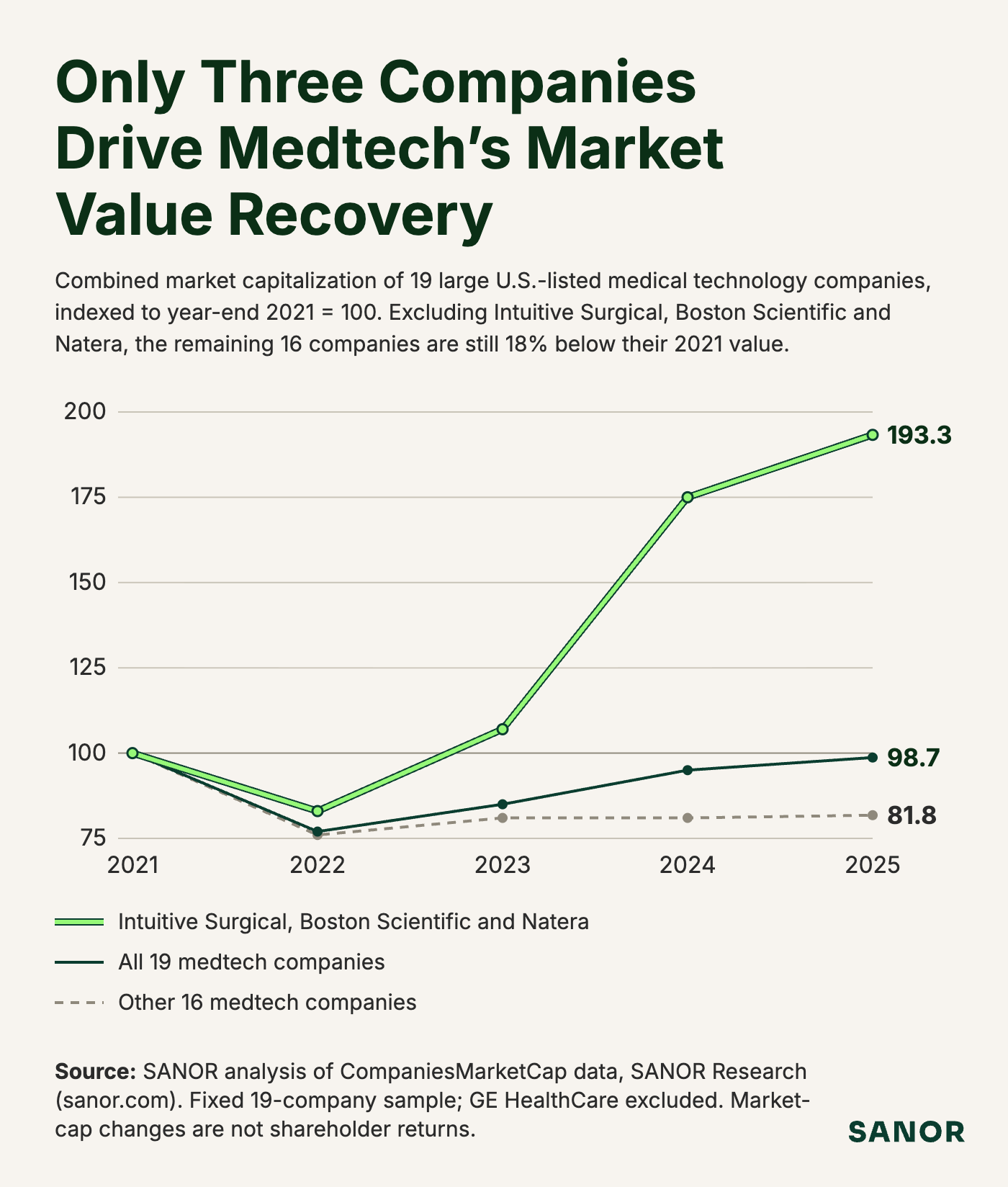
View chart dataHide chart dataRecovery by company group, 2021–2025
| Group | 2021 | 2022 | 2023 | 2024 | 2025 |
|---|---|---|---|---|---|
| Intuitive, Boston Scientific + Natera | 100.0 | 83.2 | 106.7 | 174.6 | 193.3 |
| All 19 companies | 100.0 | 76.9 | 84.9 | 95.6 | 98.7 |
| Other 16 companies | 100.0 | 75.8 | 81.0 | 81.5 | 81.8 |
Only five of the 19 companies exceeded their 2021 market caps; 14 remained below. The group’s total had almost regained its pre-decline value, but most of its companies had not.
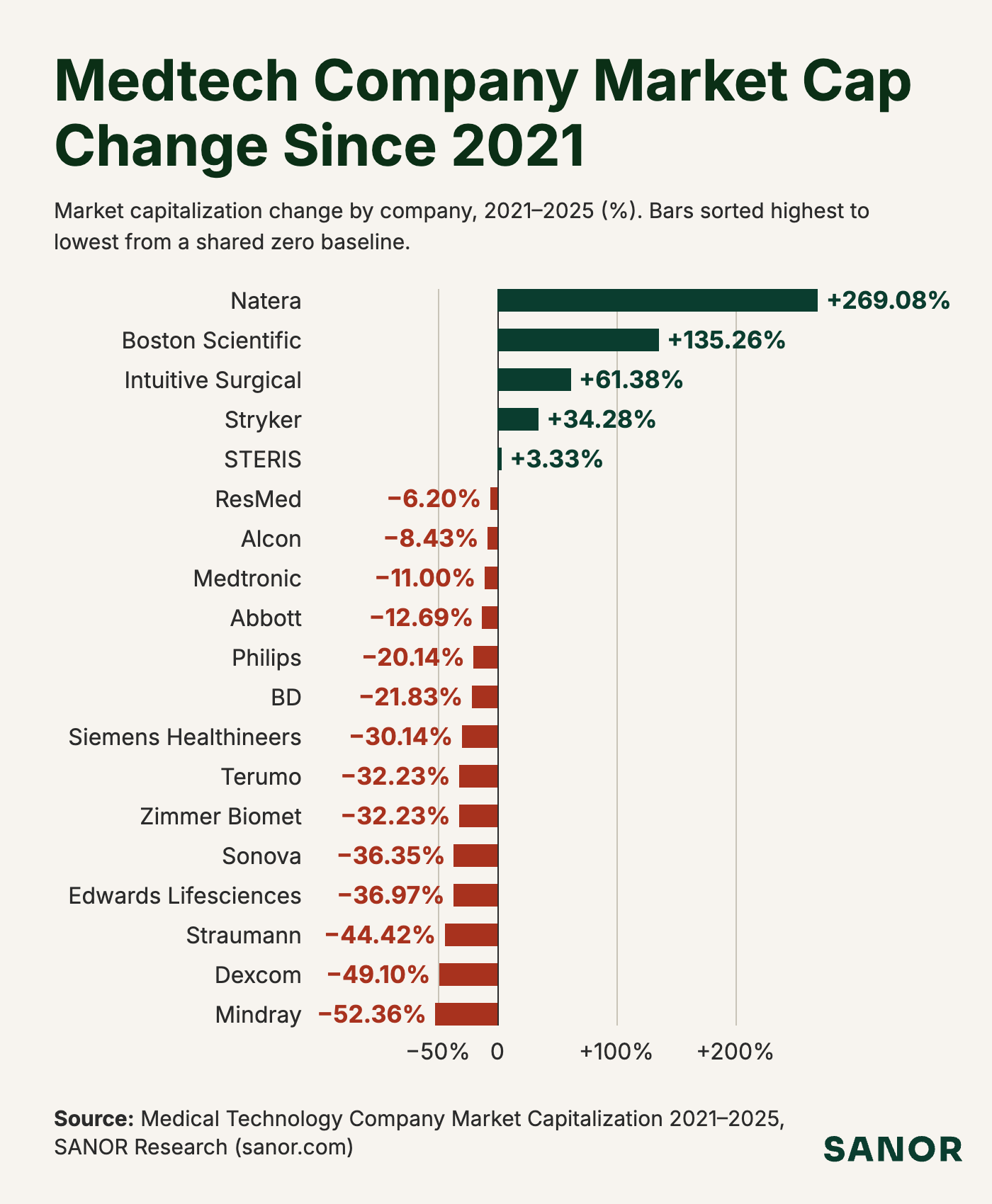
View chart dataHide chart dataMarket-cap change by company, 2021–2025
| Company | Change (%) |
|---|---|
| Natera | +269.08% |
| Boston Scientific | +135.26% |
| Intuitive Surgical | +61.38% |
| Stryker | +34.28% |
| STERIS | +3.33% |
| ResMed | −6.20% |
| Alcon | −8.43% |
| Medtronic | −11.00% |
| Abbott | −12.69% |
| Philips | −20.14% |
| Becton Dickinson | −21.83% |
| Siemens Healthineers | −30.14% |
| Zimmer Biomet | −32.23% |
| Terumo | −32.23% |
| Sonova | −36.35% |
| Edwards Lifesciences | −36.97% |
| Straumann | −44.42% |
| Dexcom | −49.10% |
| Mindray | −52.36% |
Source: SANOR analysis of calendar year-end USD market caps, 2021–2025. Market-cap changes are not shareholder returns.
Conclusion
The companies in this ranking span a wide range of medtech markets, including surgical robotics, cardiovascular devices, diagnostics, imaging, diabetes technology, dental care and hearing devices. For a closer look at the software side of medtech, explore SANOR’s ranking of the 10 largest clinical software companies in 2026.
Sanor publishes for general information. This publication is not medical, financial, or investment advice.
The Private Clinic Playbook
Grow revenue at each location and build a commercial model that can scale across a clinic group.
Sanor never sells your personal information. By providing this information you agree to Sanor’s Privacy Policy and Terms of Service.

SANOR research follows the principles of ISO 20252:2019 and the ICC/ESOMAR International Code on Market, Opinion and Social Research and Data Analytics, and is conducted in line with our Independence Policy. Our published reports follow our Editorial Standards.
SANOR research is funded through advisory engagements and research licensing. We do not accept vendor sponsorship, paid placement, or advertising.
All publications are provided for general information only. They do not constitute medical, financial, or investment advice and do not account for the circumstances of any specific business or individual.