The World’s Leading Hearing Implant Manufacturers in 2026
40 years ago, implantable hearing devices represented a medical breakthrough. Today, the market remains small by medical-technology standards but is served by manufacturers across Australia, Europe, the United States and China.
Research is still ongoing, and several companies are making progress. But Cochlear is still the top-selling manufacturer, with all other competitors well behind.
But a new technology may change the competitive picture: the totally implantable cochlear implant (TICI), designed to provide hearing without an externally worn sound processor.
This study examines the state of the implantable hearing device industry in 2026.
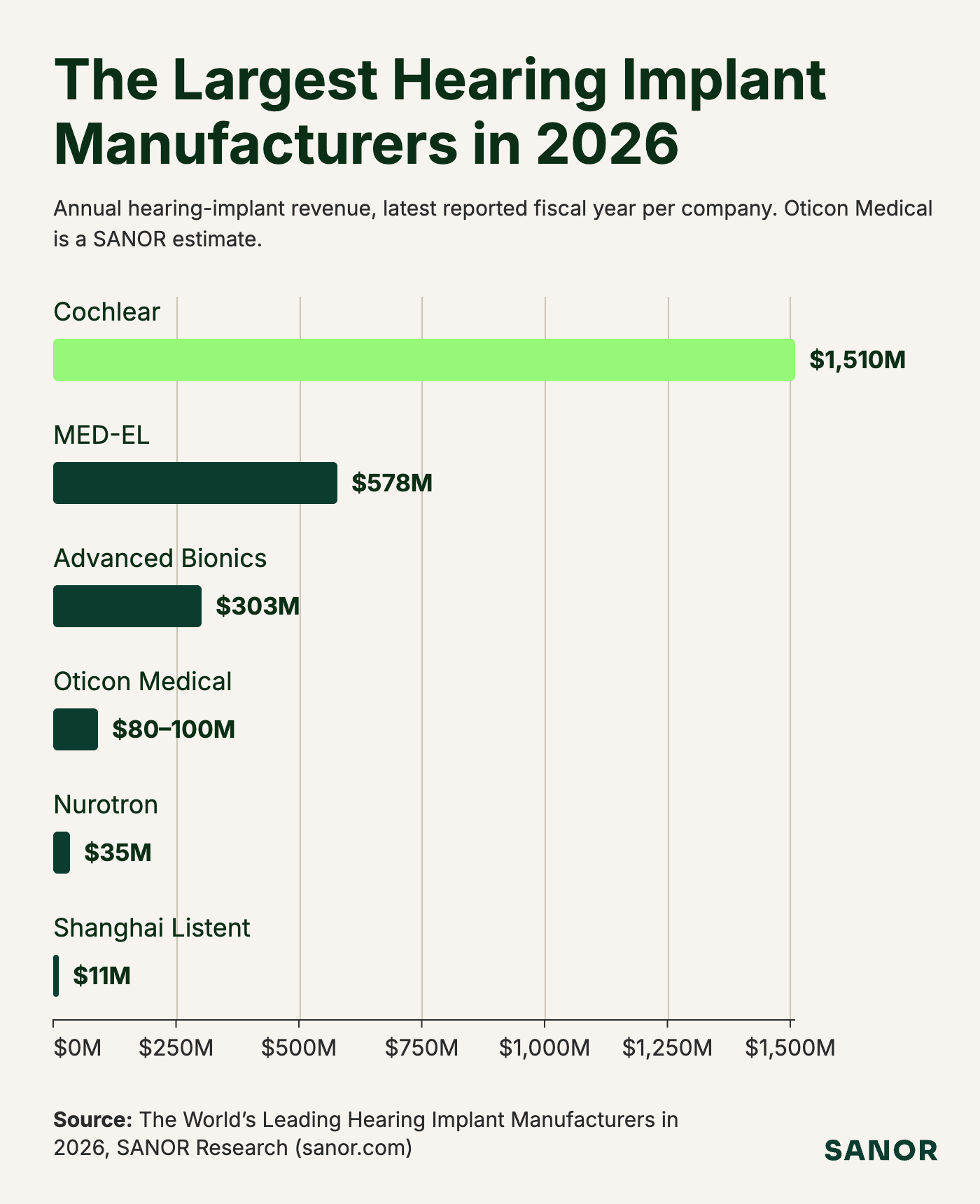
Our detailed ranking follows the graphic below.
1. Cochlear Limited

- Headquarters: Sydney, Australia
- Ownership: Publicly listed on the Australian Securities Exchange (ASX: COH)
- Implant Categories: Cochlear and bone-conduction systems
- Revenue: A$2,343.4 million (≈ US$1.51 billion) in FY2026 (Australian dollars), year ended June 30, 2026
What They Do: Cochlear makes cochlear implants, bone-conduction implants, processors and accessories. Its Nucleus cochlear implants help those with sensorineural hearing loss. Cochlear’s Baha and Osia devices, meanwhile, cater to patients with conductive or mixed hearing loss and those with single-sided deafness. These products are known as Acoustics.
Additionally, Cochlear generates income from replacement sound processors, categorized under its Services segment.
Cochlear’s revenue growth slowed from 12% in FY2024 to 3% in FY2025 and 2% in FY2026, measured at constant exchange rates.
In FY2026, the company sold 56,692 cochlear implants, up 5% compared to FY2025.
But the company’s overall revenue from implants in FY2026 was flat, as lower-priced units in emerging markets accounted for a larger share of sales.
TICI development: Cochlear’s ENTERPRISE pivotal study is active but no longer recruiting, with primary completion estimated in April 2027. A second pivotal study, ELEVATE, began in the United States in April 2026 and is recruiting, with primary completion estimated in October 2027.
2. MED-EL

- Headquarters: Innsbruck, Austria
- Ownership: Privately held
- Implant Categories: Cochlear, middle-ear, auditory brainstem and bone-conduction systems
- Revenue: €511.8 million (≈ US$578 million) in FY2024, year ended November 30, 2024; consolidated group revenue
What They Do: MED-EL manufactures hearing implants that include cochlear, middle-ear, auditory brainstem and bone conduction implants, as well as non-implantable devices.
The company reported revenues of €485.0 million (≈ US$547 million) in FY2023 and €511.8 million (≈ US$578 million) in FY2024, an increase of 5.5% on a reported euro basis.
Revenue grew in Europe and the Americas and fell in the Asia-Pacific region.
MED-EL (Elektromedizinische Geräte GmbH) is the second-largest company in this space. But revenues are still less than half those of Cochlear, and the available accounts do not establish a sustained gain in global market share.
Notable Transactions: Its acquisition of two gene therapy programs in May 2026, targeting the MYO7A and STRC genes, extends its research into genetic causes of hearing and balance disorders.
TICI development: MED-EL completed its 30-participant pivotal study in September 2025, though results had not been posted as of September 15, 2026. Regulatory and commercial outcomes are still to be established.
3. Advanced Bionics

- Location: United States; parent company headquartered in Switzerland
- Ownership: Sonova
- Implant Category: Cochlear implants
- Revenue: CHF252.1 million (≈ US$303 million) in FY2025/26, ended March 31, 2026
What They Do: Advanced Bionics makes cochlear implants and sound processors such as the Naída CI Marvel and Sky CI Marvel. As part of Sonova, it shares technology with Sonova’s Phonak hearing aid brand. This allows it to offer products for people who use an implant in one ear and a hearing aid in the other.
The Advanced Bionics segment saw revenue increase 3.6% in FY2023/24 and 9.5% in FY2024/25, then decrease by 11.1% in FY2025/26, all in local currency terms, according to reporting from their Swiss parent company.
Reported sales moved from CHF278.9 million (≈ US$336 million) to CHF303.9 million (≈ US$366 million) and then CHF252.1 million (≈ US$303 million). Sonova attributed the decline to China’s procurement changes and pressure from their biggest competitor’s recent product launch.
TICI development: No company-disclosed clinical milestone was identified in the materials reviewed. Sonova’s FY2025/26 outlook instead highlights a planned new sound processor, subject to approvals.
4. Oticon Medical

- Headquarters Country: Sweden
- Ownership: Impilo, following the March 2026 ownership transfer
- Implant Category: Bone-conduction systems
- Estimated Revenue: US$80–100 million for calendar 2025; SANOR estimate
What They Do: Oticon Medical makes Ponto and Sentio, both bone-anchored conduction systems. Unlike the other companies listed above, Oticon focuses on bone-anchored systems — they sold their cochlear implant operation to Cochlear in 2024.
Notable Transactions: Demant sold Oticon Medical to Impilo in March 2026 but agreed to work with Impilo on processor development, manufacture and supply.
Methodology Note: We used Demant’s accounting for the discontinued operation to estimate sales of around US$80m–$100m for 2025, after subtracting EPOS’s separately disclosed revenue.
Demant described good growth when announcing the sale, without quantifying it. However, because the business scope has changed and its numbers were reported together with EPOS, we cannot reliably compare recent growth rates for the remaining bone-conduction business.
TICI development: The current bone-conduction business falls outside this race; its former cochlear operation is now part of Cochlear.
5. Nurotron

- Headquarters: Hangzhou, China
- Ownership: Privately held, unlisted joint-stock company; Hangzhou municipal and Yuhang district state-owned investment vehicles became significant shareholders in May 2025, with the stake size not disclosed
- Implant Category: Cochlear implants
- Revenue: RMB250 million (≈ US$35 million) in calendar 2023
- International Sales: Approximately 20% of reported 2023 revenue
What They Do: Nurotron develops cochlear implants and speech processors for domestic and international markets. Overseas sales (outside China) accounted for approximately 20% of its reported 2023 revenue.
According to Chinese business reporting, revenue doubled to RMB250 million (≈ US$35 million) in 2023. The increase comes from a small initial base and an older reporting period. Later forecasts have not been treated as achieved results.
Nurotron was selected as one of the five authorized suppliers in China’s national cochlear-implant procurement program. This program gives Nurotron access to government contracting opportunities, albeit at sharply lower prices.
Whether volume from Chinese state purchases will offset the lower per-unit prices cannot yet be determined.
TICI development: Nurotron’s April 2025 patent application documents a proposed design that retains an external microphone. This application demonstrates that development has occurred, though it lacks clinical trial outcomes or a projected launch timeline.
6. Shanghai Listent

- Headquarters: Shanghai, China
- Ownership: Part of Xinxing Cathay International Group’s medical business
- Implant Category: Cochlear implants
- Revenue: RMB79.4 million (≈ US$11 million) in calendar 2025
What They Do: Shanghai Listent develops cochlear implants and sound-processing technology. It is part of Xinxing Cathay International Group’s medical business, with Hainan Haiyao holding a minority stake and reporting its financial results.
Hainan Haiyao disclosed Listent revenue of RMB134.4 million (≈ US$19 million) in 2023, followed by RMB147.2 million (≈ US$21 million) in 2024 and RMB79.4 million (≈ US$11 million) in 2025. That represents growth of 9.5% in 2024 and a decline of 46.1% in 2025.
The shareholder linked lower profit to a narrower price gap between domestic and imported products and reduced sales volumes. Listent’s reversal shows that lower prices for imported systems can also weaken a domestic manufacturer’s position.
TICI development: Listent’s patent application published in June 2026 documents an optical sensing approach. However, sources reviewed did not indicate any human trial results or discernible commercial timetable.
Other Manufacturers and Developers
Envoy Medical is a smaller developer to watch. Its investigational Acclaim program had entered the U.S. modular approval-submission process by August 2026. The company is relevant to future competition, although Acclaim is not yet an established commercial product.
Can the Challengers Close the Gap?
These company profiles suggest there are multiple ways to challenge Cochlear for market share: gain new-system sales, compete in a specific category, or develop a product that changes customer preferences.
Their success will depend on six factors:
1. Advanced Bionics has gained share, but growth has been uneven
In FY2024/25, Advanced Bionics’ implant-system sales grew 16.3% in local currencies, compared with 9% for Cochlear’s implant revenue in FY2025. Sonova reported market-share gains.
The fiscal years end three months apart, so the growth rates offer an approximate comparison. The following year’s reversal shows the difficulty of sustaining that gain. Sustained success against Cochlear will likely require a steady stream of new products, coupled with strong global sales and marketing efforts.
2. Cochlear enjoys a substantial stream of revenues from existing patients
Cochlear generated A$634.9 million (≈ US$410 million) from replacement processors, accessories and other services in FY2026. That’s more than what Advanced Bionics made on their implant segment as a whole, which was around US$303 million.
A competitor will need to sell new systems while Cochlear can continue to make money on replacement processors. Upgrade sales still fluctuate. Advanced Bionics’ revenues from this source fell 13.1% in local currency in FY2025/26 as the Marvel upgrade cycle matured.
New-system sales and replacement sales therefore need to be assessed separately when judging a manufacturer’s growth.
3. Lower prices can hurt domestic suppliers as well as imports
China’s procurement program reduced average implant-and-processor package prices from more than RMB200,000 (≈ US$28,000) to around RMB50,000 (≈ US$7,000), according to official communications. These are equipment procurement prices, excluding surgery, rather than a direct measure of manufacturers’ net revenue.
Lower procurement prices change the arithmetic for every supplier. Additional units must compensate for lower revenue per system. The narrowing price gap with imported products can also erode the cost advantage on which domestic suppliers compete.
4. Competition differs by product and country
In 2023, the UK Competition and Markets Authority blocked Cochlear’s proposed acquisition of Oticon Medical’s bone-conduction business. It found that the combined businesses would account for more than 90% of the relevant UK market, while allowing the cochlear-implant transaction to proceed.
Oticon Medical’s relatively small global revenue understates its importance in that category. A manufacturer can offer meaningful competition in a particular market without approaching Cochlear’s overall size. Global revenue rankings cannot resolve those differences.
5. Funding helps turn innovation into a competitive advantage
Cochlear spent A$323.2 million (≈ US$208 million) on research and development in FY2026. That gives it resources to respond to challengers while advancing several programs. The figure covers its wider portfolio, rather than TICI alone.
For challengers, the commercial test is whether a development advantage can survive the costs of trials, approval, manufacturing and long-term support. The TICI milestones outlined above create potential openings, but the eventual effect on market share will depend on execution after the research stage. Cochlear’s scale gives it the means to compete even if a rival reaches an earlier milestone.
Our separate analysis, The Billion Dollar Race for a Totally Implantable Cochlear Implant, compares the programs, their evidence and the next milestones to watch.
6. Gene therapy expands the research agenda
MED-EL’s MYO7A and STRC gene therapy programs address specific genetic conditions and remain in development. The STRC program concerns a population currently managed primarily with hearing aids. These investments broaden the company’s research opportunities beyond its existing device portfolio.
Their commercial contribution will depend on future clinical and regulatory progress. They add a longer-term dimension to MED-EL’s strategy, while the current ranking continues to reflect its existing business.
Conclusion
Cochlear’s lead rests on new implant sales, an established recipient base and the resources to keep developing its portfolio. Rivals can challenge different parts of that position: Advanced Bionics through stronger system sales, MED-EL through its product range and development pipeline, and smaller manufacturers through focused market opportunities.
The next test is whether those opportunities produce sustained growth across several markets. Revenue from new systems, the durability of upgrade sales and the commercial uptake of new products will provide a clearer measure than any single year’s growth or clinical milestone.
Next read: The Billion Dollar Race for a Totally Implantable Cochlear Implant
Methodology and Limitations
Scope: This report compares six leading manufacturers of complete hearing-implant systems. It is not an exhaustive company count or a clinical assessment of their products. Revenue includes related processors, upgrades and accessories where disclosed. Unrelated parent-company businesses, component suppliers and healthcare-provider treatment revenue are excluded where possible.
Reporting periods: “In 2026” refers to the ranking date. Revenue periods differ and are stated in each profile. Historical figures have not been extrapolated into 2026. Limited private-company disclosure makes the lower positions indicative.
MED-EL: Revenue uses the FY2024 consolidated financial statements, including FY2023 comparatives, reproduced by FirmenABC. These group figures primarily cover hearing-implant systems but also include other bone-conduction hearing systems, service and repairs; they are not a pure implant-only segment disclosure.
Oticon Medical estimate: Demant reported DKK1,153 million (≈ US$174 million) in combined discontinued-operations revenue for 2025. Subtracting EPOS’s approximately US$90 million in 2025 revenue produces a central estimate near US$84 million.
SANOR uses a US$80–100 million range to allow for currency effects, rounding and potential differences in business scope. This is an analytical estimate, not company-reported revenue or a statistical confidence interval.
Currency conversion: ≈ denotes an approximate USD equivalent. Rounded equivalents use 2025 annual-average exchange rates published by the IRS. Growth comparisons use original reporting currencies, as described below.
Growth comparisons: Cochlear and Sonova growth rates use company-reported constant or local currencies; MED-EL and Listent rates are calculated from reported euros and yuan. These measures are not identical, and fiscal year ends differ.
Nurotron’s 2023 growth is based on attributed business reporting; subsequent forecasts are not treated as achieved results. Oticon Medical lacks a comparable standalone series in the sources reviewed.
Market share: Revenue benchmarks have not been converted into global market-share percentages because reporting periods, product scope and disclosure are not sufficiently consistent.
TICI development status: Company and trial milestones were reviewed as of September 15, 2026. The linked standalone analysis provides the detailed evidence and limitations. Patent filings, completed studies and approval submissions are distinct milestones.
Sanor publishes for general information. This publication is not medical, financial, or investment advice.
The Private Clinic Playbook
Grow revenue at each location and build a commercial model that can scale across a clinic group.
Sanor never sells your personal information. By providing this information you agree to Sanor’s Privacy Policy and Terms of Service.

SANOR research follows the principles of ISO 20252:2019 and the ICC/ESOMAR International Code on Market, Opinion and Social Research and Data Analytics, and is conducted in line with our Independence Policy. Our published reports follow our Editorial Standards.
SANOR research is funded through advisory engagements and research licensing. We do not accept vendor sponsorship, paid placement, or advertising.
All publications are provided for general information only. They do not constitute medical, financial, or investment advice and do not account for the circumstances of any specific business or individual.